
Every question, answered
Sixty questions. Straight answers.
Pricing, delivery, billing, permits, winter, power, insurance and pickup — sixty questions we get on the phone, each answered with the real number.
Pricing
Every number on this page is read from the same price list as the pricing page, the reservation flow and the invoice, so it changes in one place or not at all. Start here if you only want to know what a unit costs.
How much does a 20 ft office container cost to rent?
A 20 ft Base office is $795/mo on a 3-month minimum. Grid-Free, which builds in WATCH, CONNECT and POWER plus the battery pack that runs the HVAC, is $1,495/mo, and Alpine, everything in Grid-Free inside the mountain envelope with backup heat, is $1,895/mo. The 40 ft office with a bathroom is $1,595/mo on the same minimum. All four rents are before delivery, upgrades, the protection you choose and tax; the 20 ft office page sets the tiers side by side, and the mobile office rental cost guide goes deeper on what a season costs.
How much does a storage container cost per month?
The 20 ft storage container is $295/mo and the 40 ft high-cube is $425/mo; both are one-trip boxes with a welded lockbox. The two tight-site units are priced by what they carry, not by their length: the 12 ft is $325/mo and the 10 ft is $225/mo, each with a man door and a barred window on the long side, and the 10 ft is the lowest rent in the fleet. Every storage container carries a 1-month minimum except the 40 ft, which carries 3. The per-month cost answer puts those rents next to delivery and protection.
What does delivery cost?
A flat fee by zone, each way, from the yard in Gypsum: $400 in Zone A (Gypsum, Eagle, Edwards, Avon and Beaver Creek), $550 in Zone B (Vail, Minturn, Wolcott and Glenwood Springs), $750 in Zone C (Summit County and the Roaring Fork Valley), $950 in Zone D (Steamboat Springs, Leadville, Grand Junction and Buena Vista) and $1,200 in Zone E (the I-70 foothills and the Denver metro). Zone F, the Mountain West states, is $1,795 for delivery, with pickup quoted in writing before delivery. The fee covers our truck, our driver and placement where your representative directs; the delivery zones page lists every town with its zone.
What is the minimum rental term?
Offices and the 40 ft storage container carry a 3-month minimum. The 10, 12 and 20 ft storage containers, fence, light towers, ground heaters, traffic control and hand-wash stations carry a 1-month minimum. After the minimum, every rental runs month to month until you give 15 days' written notice of pickup, under section 3 of the Rental Agreement. The exception is Zone F: a placement in Wyoming, Idaho, Utah or Montana carries a 12-month minimum whatever the unit.
Is the price on the website the price I pay?
Yes. The site, the reservation flow and the invoice read one price list, so the rent, upgrade and fee you see here is the number that is charged. The lines that vary by job are the delivery zone, the protection you choose (a 12% damage waiver or a deposit plus insurance), the 5% environmental fee and sales tax, which depends on the job address, and every one of them is published before you reserve. The one number we quote rather than print is Zone F pickup, and that quote is in writing before delivery.
Reserving a unit
Every reservation on joltrents.com is a specific unit from live inventory, held with a deposit of $750 for an office or 40 ft storage container and $350 for a smaller storage container. These questions cover the part of the process that happens before a truck moves; how it works walks through the whole sequence in order.
Do I have to reserve online, or can I call?
Either. The reservation flow shows live availability, takes the deposit and emails the confirmation once the payment clears. If you would rather talk, call 970-279-1015 during business hours and we build the same reservation on the same prices while you are on the phone; email to reserve@joltrents.com works too, and the short form on the contact page returns a price sheet on screen the moment you send it. Nothing is cheaper or faster through one channel than another.
What does the reservation deposit actually do?
It takes one unit out of the pool and puts your delivery window on it, under section 2 of the Rental Agreement. Until the deposit is paid, the availability badge on the product page still counts that unit as free, so a phone call without a deposit is a conversation, not a hold. On delivery the deposit is applied to your first invoice, which carries the first month's rent, the delivery fee and any upgrades, so you never pay it on top of the rent. The deposit list on the pricing page shows the amount for every unit.
Is the reservation deposit refundable?
Yes, in full, if your written cancellation reaches reserve@joltrents.com more than 14 days before the first day of your delivery window. Cancel inside 14 days, or fail to accept delivery, and the deposit is forfeited, because by then the unit has been pulled from the pool and fitted for you. Go ahead with delivery and it is not refunded at all; it is credited against your first invoice. If we cannot supply the unit you reserved, section 2 has us substitute equal or better equipment at the same price or refund the deposit in full.
Can I reserve a unit for a job that starts in three months?
Yes, and it is the right move on a mountain job with a fixed mobilization date. You choose the delivery window when you reserve, and the deposit holds the unit for that window whether it is three weeks out or three months. If the schedule slips, tell us in writing more than 14 days before the first day of the window: a cancellation is free at that point, so moving the window costs nothing, while inside 14 days the terms in section 2 apply. Reserving early also leaves time to add upgrades in the yard rather than on delivery morning.
Do you rent to homeowners or only to contractors?
JOLT is built for business and commercial customers, and the Terms of Service say so. That covers general contractors, subcontractors, resort operators, districts, utilities, event producers and ranches, and it covers a homeowner acting as an owner-builder on a permitted project who can sign the Rental Agreement as an adult and take responsibility for the site. A container is never a residence: sleeping in any unit is a prohibited use under section 7 of the Rental Agreement.
What if the unit I want shows none available?
Then there are none, and we will not pretend otherwise. The badge on every product page reads the fleet, so a zero means every unit of that type is on a job or already reserved. Call us and we will tell you the next real window as units come back, or point you to the closest substitute: a 40 ft office instead of two 20 ft units, a 12 ft box where the 10 ft is out, a Grid-Free where the Base pool is empty. We never mark a unit "limited" to hurry you.
How do I reach a person?
Call 970-279-1015 or email reserve@joltrents.com, Monday through Friday, 7:00am to 7:00pm Mountain Time; the yard is at 60 Spring Creek Rd in Gypsum, on I-70. During business hours you get a response within 15 minutes, and a message left after hours is answered the next business morning. The contact page has the form, which is the fastest way to get a price sheet for a specific unit and town without waiting for a call back.
Delivery
Every unit ships from the yard at 60 Spring Creek Rd in Gypsum on our own truck, inside the 2–4 week window you pick at reservation. The delivery zones page covers fees and towns; these questions cover where we go and the day itself.
Where do you deliver?
The Colorado mountains and Front Range from Gypsum: Eagle County and the Vail Valley, Glenwood Springs and the Roaring Fork Valley to Aspen, Summit County, Leadville, Buena Vista, Steamboat Springs, Grand Junction, the I-70 foothills and the Denver metro, each priced by zone. Beyond Colorado, Zone F covers Wyoming, Idaho, Utah and Montana on a 12-month minimum, with pickup quoted in writing before delivery. Every town we price is on the delivery zones page with its zone and fee, and the Colorado locations hub links to a page for each one. An address outside the published zones gets a written delivery quote before anything is charged.
How fast can you deliver?
The standard delivery window is 2–4 weeks from reservation for every unit, and your reservation states the window. The time goes to assigning the equipment, fitting the upgrades you chose, checking the unit and building the truck schedule around mountain roads and active jobsites. If you need a 20 ft Base office sooner, JOLT Express puts one on site within 7 business days for a one-time $750; no other unit has a fast lane. Reserve as soon as the job address and site plan are stable, and the window works in your favor.
When do you confirm the actual delivery date?
Inside the window, once the unit is fitted and the truck schedule is set, and always before the truck is loaded; you get the date in writing, and a representative of yours needs to be on site to receive the unit. Mountain deliveries are scheduled around road and pass conditions in winter, which is why the window is a window and not a date: a storm can move a Tuesday to a Thursday without moving you out of your window. Do not treat a day discussed before confirmation as the schedule.
What is JOLT Express and which units qualify?
JOLT Express puts a 20 ft Base office on site within 7 business days of reservation for a one-time $750, paid at reservation on top of the zone fee. It applies to the Base tier only; Grid-Free, Alpine, the 40 ft office and every storage container, fence and equipment unit ship in the standard window. Express changes timing, not the requirements: the same access, placement and representative rules apply, and it is a window, not a promised day. The how it works page compares it to the standard window line by line.
What kind of truck delivers, and how much room does it need?
A tilt-bed or flatbed truck that sets the container down off its rear end onto your pad, which means it needs to approach in a straight line and pull forward as the box comes off. Plan on about 70 ft of straight-line clearance for a 20 ft unit and 100 ft for a 40 ft unit, plus room overhead for the bed to tilt, on ground that carries a loaded truck. The site requirements in section 5 of the Rental Agreement are the checklist we work from; the truck size answer and the mountain delivery guide show how tight driveways, switchbacks and soft shoulders play out.
Can you place a container on a slope or on snow?
On a gentle slope, yes, with blocking under the low corners so the doors swing true; on a real grade, no, because the unit racks and the doors bind. Snow is not a surface: the Rental Agreement asks for a firm, level, well-drained pad, so a winter placement needs the pad graded and compacted before the snow flies and plowed so the driver can see it and reach it. The pad that carries a box in January can turn to mud in April, so think about the thaw when you pick the spot. The slope answer covers blocking and the foundation answer covers gravel, asphalt and native ground.
What happens if the truck arrives and cannot deliver?
You owe the delivery fee for that trip and for the next one, and if the driver waits while the site is cleared, the waiting time; the amounts are in section 5 of the Rental Agreement. A failed delivery is almost always a locked gate, a parked truck in the approach, an unmarked utility, a missing representative or a pad that turned to mud, and every one of those is visible the day before. Send a photo of the pad and the approach when you reserve, and walk the site the morning of delivery.
Billing
Every recurring line on a JOLT invoice is published on the pricing page: rent, upgrades, a 12% damage waiver if you choose it and a 5% environmental fee, plus the one-time fees. These questions cover how those numbers turn into a monthly statement.
Which charges are monthly and which are one-time?
Monthly: rent, any upgrades, the damage waiver at 12% of rent plus upgrades if you chose it over a deposit and insurance, and the environmental fee at 5% of the same base. One-time: the delivery fee, the pickup fee, JOLT Express at $750, BRAND at $450, on-site relocation at $450 per move, and fence install and removal at $1.75 per linear foot each. The reservation deposit is not a charge at all; it is a credit against the first invoice. Every price is before tax, and sales tax is its own line.
How does auto-pay work?
Every account is on auto-pay by card or ACH, billed monthly in advance, with one invoice per unit so a superintendent can code each box to its own job; base rent and each upgrade are separate lines on it. Delivery, Express, branding, relocation and other one-time work appear when incurred rather than being folded into rent. You keep a valid payment method on file for the whole rental; under section 4 of the Rental Agreement a failed payment accrues a late fee and interest and can suspend upgrades. There is no net-30 option at launch and no credit application for a standard rental; a purchase order can reference the Order, but its terms do not override the Rental Agreement.
Do you charge sales tax?
Yes, where the job's jurisdiction taxes equipment rental. Every price on this site is before tax, and tax is its own line at checkout and on each invoice, calculated on the job address rather than your office address. If your organization is tax-exempt, send the exemption certificate to reserve@joltrents.com before delivery, as section 4 of the Rental Agreement requires, so the account is flagged before the first invoice runs.
What is the environmental fee?
A 5% line on every invoice, calculated on rent plus recurring upgrades and not compounded on the damage waiver. It is the same percentage on a 10 ft box and a 40 ft office, it is printed on the pricing page next to the waiver rather than buried in a "service" line, and with rent, upgrades and the waiver you chose it is the whole recurring side of the invoice. If a unit needs refueling or cleaning at return, those are separate one-time lines under the Rental Agreement, not part of this fee.
Do rates go up during a long rental?
Rates rise 5% on each anniversary of your delivery date unless your Order says otherwise, per section 3 of the Rental Agreement, so a job under a year never sees the escalator and a two-year rental sees it once. Month-to-month rates after the minimum term can change on 30 days' notice. Upgrades are separate lines at their published rates, so you can see exactly what any change applies to.
Storage containers
Four sizes, from $225/mo for the 10 ft to $425/mo for the 40 ft high-cube. The 20 ft and 40 ft are one-trip ISO boxes with a welded lockbox; the 10 ft and 12 ft are tight-site units with a man door and a barred window on the long side. The storage container pages carry the full specs; these are the questions that decide between them.
What is a one-trip container?
A container that made one loaded ocean crossing from the factory and was then sold into domestic service instead of being cycled through shipping for a decade. One-trip boxes have straight walls, tight door seals, intact floors and original paint, which is why they are the standard for jobsite storage where the doors get opened forty times a day. The one-trip answer explains the grade, and the one-trip versus used comparison shows what a decade at sea does to a box.
Are the containers weatherproof?
Yes. A one-trip container is wind- and watertight by construction: corrugated steel walls, a steel roof, a plywood floor over steel cross-members and gasketed cargo doors. What it is not is insulated or ventilated, so tools and materials that mind condensation belong on shelves off the floor, and a box in full sun on a July afternoon in Grand Junction is hot inside. The waterproofing answer covers seals, condensation and the fixes.
What size storage container do I need?
A 20 ft container covers a footprint of 8 by 20 ft, a 40 ft covers 8 by 40 ft, and the 12 ft and 10 ft cover 8 by 12 ft and 8 by 10 ft. Most trades on a single-family build run one 20 ft; a GC on a commercial job runs a 40 ft or two 20s so that trades keep their own keys; a residential lot in Vail or a lane closure fits only a 10 ft or 12 ft. The 20 ft container weight answer has the tare weights if your pad or your crane needs them.
Can I put my own lock and shelving in a container?
Yes to both, with limits. Bring your own padlock; on the 20 ft and 40 ft the welded lockbox shields the shackle from bolt cutters. Freestanding shelving is fine, and the 10 ft and 12 ft units have a man door on the long side so you can walk in and use both walls. What you cannot do is weld, cut, drill or paint the unit or hang shelving from the walls, per section 7 of the Rental Agreement, and at pickup the box has to be empty and free of anything attached.
Office containers
Three 20 ft tiers and one 40 ft unit with a bathroom, from $795/mo for a Base. The 20 ft office page explains each tier; these questions are the ones a superintendent asks before choosing.
What is the difference between Base, Grid-Free and Alpine?
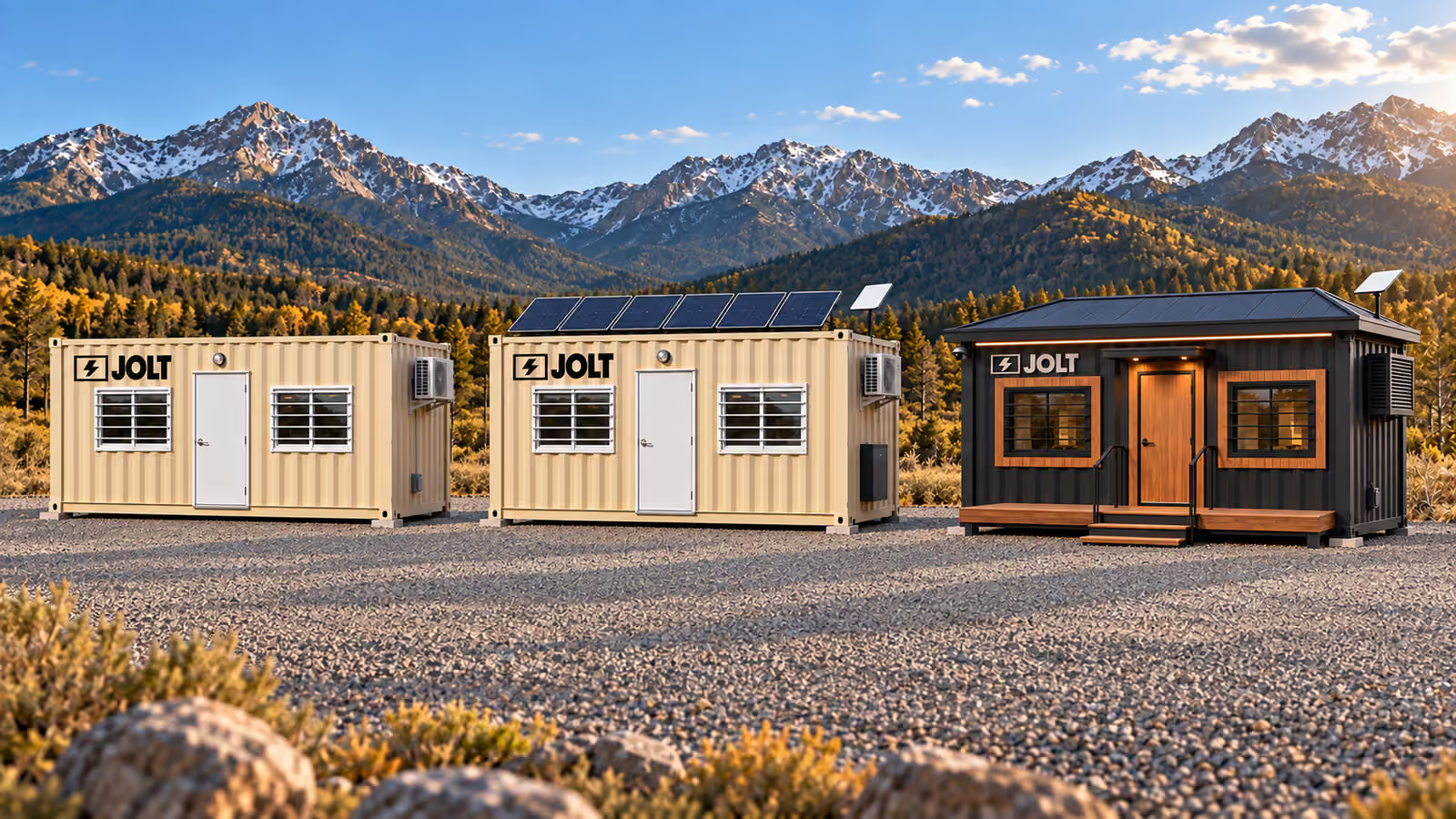
Base is the working office: a 20 ft ISO container with a 36-inch steel personnel door, two barred slider windows, a mini-split for heat and cooling, a 50-amp shore-power inlet, lights, outlets and a vinyl-plank floor. Grid-Free is a Base with WATCH, CONNECT and POWER built in plus a 10 kWh battery pack that runs the HVAC, so it needs no shore power at all. Alpine is Grid-Free in a mountain envelope: matte black with cedar surrounds, a standing-seam over-roof, a covered entry deck and backup heat. The tier comparison on the 20 ft office page sets the three side by side.
Does the office come with power?
The Base and 40 ft offices have a 50-amp shore-power inlet, so on a site with temporary power you connect through it and everything runs. Without temporary power you have two options. The POWER upgrade at $399/mo runs Starlink, the camera, LED lights, laptops and phones, for about two days without sun at those loads, but not the mini-split. The Grid-Free and Alpine tiers carry the larger pack that does run the mini-split, and they are the answer for a remote site or one that is still waiting on its electrical service; the powering-an-office answer works through the choice.
Does the office have heat and air conditioning?
Yes. Every office is insulated and has a wall-mounted mini-split that heats and cools. Alpine adds backup heat for the nights when a mini-split alone is working hard, and the READY upgrade includes a 1,500 W wall heater with a thermostat that can hold the room while the mini-split is defrosting. Heat needs power, which is why POWER alone does not carry the HVAC and Grid-Free and Alpine do; the heating answer covers the equipment in detail.
Can two people work in a 20 ft office?
Comfortably. The interior of a 20 ft container is a little under 8 ft wide, and the READY kit puts a plan table and two chairs at one end with a whiteboard, a mini-fridge and a microwave along the side. Three people work if one of them lives on a laptop; four is a meeting, not an office, and that is when the 40 ft office with bathroom earns its rent. The 20 ft versus 40 ft guide has the floor plans.
Is a container office better than an office trailer?
For a mountain site, usually. A container sits on the ground at truck-bed height without a ramp, it does not need tires, axle blocking or skirting, it locks like a steel box because it is one, and it does not rock in wind. A trailer wins when the project needs a width or length outside 20 and 40 ft or a particular floor plan that only a trailer offers. The container office versus office trailer comparison works through both cases, and the ground-level office answer explains why the step-free door matters.
Power, connectivity and JOLT Upgrades
Four kits from $129/mo a month that stack on Base and 40 ft offices and storage containers, billed with the rent. The upgrades page has every spec; these are the questions we hear before and after a unit is on site.
What are JOLT Upgrades?
Four recurring kits that bolt onto any storage or office container in our yard before delivery, or in a later month on request. WATCH is a solar LTE panoramic camera with motion alerts and cloud clips at $129/mo, CONNECT is a Starlink Mini and router on a 50 GB Roam plan at $259/mo, POWER is two 400 W panels, a 3 kWh battery and an inverter at $399/mo, and READY is a plan table, two chairs, a whiteboard, a mini-fridge, a microwave and a 1,500 W heater at $125/mo. The JOLT Pack bundles WATCH, CONNECT and POWER for $699/mo. The hardware stays JOLT's; you rent the working system for the months you need it.
Can I add an upgrade after delivery?
Yes, at delivery or in any later month, with no new contract. Call or email, we coordinate access and the installation rather than shipping a loose kit for the crew to improvise, and the new line joins the same invoice as the unit. WATCH and CONNECT mount to the exterior, POWER adds a roof rack and battery cabinet, and READY arrives as furniture through the door; all of it comes off at pickup as part of return processing, so do not disconnect or remove the hardware yourself. The how it works page covers mid-rental additions step by step.
Does WATCH need WiFi or power from the office?
Neither. The WATCH camera is solar-charged with its own battery and carries its own LTE SIM, which is why it works on a storage container in a field as well as on an office. You get motion alerts on your phone, cloud clips and night vision, provided the site has cellular service. A second camera on the far corner of the site is $60/mo a month, and the security camera answer covers placement.
How much data does CONNECT include?
The CONNECT kit is a Starlink Mini on the roof and a router inside on a 50 GB Roam plan for $259/mo a month. Fifty gigabytes covers plans, email, video calls and a shared drive for a crew office; a site that streams camera feeds or runs a design office through it wants unlimited data at $75/mo more. The Starlink cost answer shows what a month of jobsite traffic looks like.
Does POWER run the air conditioner?
No. POWER is two 400 W panels, a 3 kWh LFP battery and an inverter, sized for Starlink, the camera, LED lights, laptops and phone chargers for about two days with no sun. A mini-split pulls far more than that pack can sustain through a night. If you need heat and cooling without shore power, the Grid-Free and Alpine offices carry the 10 kWh pack built for it, and the off-grid power guide explains the sizing.
Can I put upgrades on a storage container?
Yes. WATCH on a 20 ft storage container is the most common pairing in the fleet, because a locked box full of tools is the thing that gets stolen. CONNECT and POWER mount to storage containers the same way they mount to offices, which turns a plain box into a connected tool crib with charging inside. Fence, light towers, heaters, traffic control and hand-wash stations take no upgrades.
Site preparation and permits
A firm, level pad, a straight approach and marked utilities are most of it. The jobsite setup checklist is the long version; these four questions are the ones that stop deliveries.
Do I need a permit for a container in Colorado?
It depends on the jurisdiction and on how long the unit stays. Many Colorado towns treat a container on an active, permitted construction site as temporary equipment covered by the building permit, and treat the same container on a vacant lot as a structure that needs its own approval; some resort towns regulate the color and the screening. Permits are your responsibility under section 5 of the Rental Agreement, so ask the building department before you reserve, and read the container permit answer and the Eagle County permit guide for the towns we deliver to most.
What surface does a container need?
Firm, level and well-drained: compacted road base, asphalt, concrete or graded native ground that will not turn to mud when it thaws. A container carries its load on four corner castings, so the corners are what matter; the driver uses blocks if the ground needs them to level a corner or two, and the Rental Agreement's site section makes the surface your responsibility. The foundation answer shows what works and what fails by spring.
Is overhead clearance a problem?
Sometimes. The tilt-bed raises the container's near end as the box slides off, so a low service drop, a tree limb or a canopy over the pad can stop a delivery that looked fine from the ground. Tell us about anything overhead when you reserve, send a photo of the approach, and if you are placing under wires ask the utility to confirm the height. The delivery space answer has the numbers for length and swing.
Do I need to be there when the unit arrives?
Yes. A representative of yours has to be on site to receive the unit, confirm the placement and sign; it is a condition of delivery under section 5 of the Rental Agreement. It takes a few minutes and it is your chance to say "two feet to the left" before the box is on the ground, because moving it later is a relocation on our truck at $450.
Winter and mountain sites
Every JOLT office has a mini-split and an insulated envelope; Alpine adds backup heat and a standing-seam over-roof. These five questions come from placements above 8,000 ft.
Can you work in a container office through a Colorado winter?
Yes, and crews do, from Leadville to Steamboat. Every office is insulated with mini-split heat, and the Alpine tier adds backup heat for the design-cold nights and an over-roof and covered entry deck that keep the door clear. What makes the difference is power: a mini-split needs shore power in Base and 40 ft offices or the built-in battery in Grid-Free and Alpine, and a READY heater needs the same. The winter office answer covers what to expect in a cold snap, and the heating answer covers the equipment.
Does snow load matter on a container roof?
Yes. A container roof is built for a distributed load, not for a season of wet Colorado snow left in place, and the Rental Agreement makes clearing snow and ice from roofs, panels, dishes and access paths your responsibility under section 7, with damage from failing to clear excluded from the waiver under section 12. The Alpine over-roof is a standing-seam roof that sheds. The snow load guide has the numbers by elevation.
Do you deliver when I-70 or Vail Pass is closed?
Not that day. A pass closure or a chain law moves a delivery date within your window, and we tell you as soon as we know. It does not move the fee, and it does not move you out of your window unless the closure runs for days, in which case we agree a new date with you rather than deliver into a closed site; road closures are force majeure under section 23 of the Rental Agreement. Reserving early and taking the front of the window is the best insurance against a March storm.
How does a ground heater work, and when do I need one?
The ground heater is a trailer-mounted hydronic unit that pumps heated fluid through insulated hose laid on the ground under blankets, to thaw frozen ground for excavation or to cure concrete through freezing nights. It rents for $1,450/mo in season with a $1,000 deposit, and it is the unit that keeps a foundation pour on schedule in January. You supply the fuel, under section 7 of the Rental Agreement.
Does Starlink work in a snowstorm?
Mostly. The Starlink Mini needs a clear view of the sky, so a roof mount on a container is close to ideal, and it needs to be kept clear of snow and ice, which section 7 of the Rental Agreement makes your job along with roofs and panels. Heavy, wet snow and dense cloud can slow or interrupt service for a while, as they do for every satellite link. Service depends on Starlink's network and your site conditions; section 13 sets out how upgrade services are provided, with no uptime guarantee.
Insurance, damage and security
You choose one of two protections at reservation: a damage waiver at 12% of rent plus upgrades, or a refundable deposit plus a certificate of insurance. Section 12 of the Rental Agreement is the governing text; these questions explain how it plays out.
What is the damage waiver, and do I have to take it?
The waiver is JOLT agreeing not to bill you for accidental damage to the unit, subject to a per-incident deductible and a list of exclusions, in return for 12% of rent plus recurring upgrades each month. You do not have to take it; the alternative is a refundable security deposit of one month's rent and a certificate of insurance meeting section 10. A contractor with a policy already in force can often use the certificate; a short job with no policy to lean on usually takes the waiver.
What does the waiver not cover?
The exclusions are listed in section 12.2, and the ones that catch people are theft, damage from moving the unit without us, damage from not clearing snow and ice, vandalism and graffiti, damage to upgrade hardware beyond ordinary wear, and any damage that happens while a charge is past due. The waiver is also not insurance and does not cover your liability to anyone else. Read the section before you decline a certificate of insurance; it is short.
What happens if the container is stolen?
Theft is excluded from the damage waiver, so a stolen unit is billed at its replacement value under section 9 of the Rental Agreement, which is one reason to carry the certificate of insurance and to put a WATCH camera on the box. Containers are stolen rarely and by people with a truck and a plan; a camera with motion alerts and a logo on the side ends most plans early. The jobsite theft answer covers the rest of the site.
Do I need my own insurance?
If you choose the deposit instead of the waiver, yes: property insurance on the unit and general liability coverage with the limits and the named parties set out in section 10 of the Rental Agreement, with certificates delivered before the truck rolls. If you take the waiver, the Rental Agreement does not require a policy for the unit, but your liability to others on the site is yours either way.
Who is responsible for damage to my driveway or landscaping during delivery?
You are, where the placement follows your direction on your site; section 5 of the Rental Agreement covers it. A loaded truck is heavy, and an asphalt driveway in July or a lawn in May will show it; if the only route is over something you care about, put down road plates or choose a pad we can reach from the street. Walk the route with the driver before the truck rolls onto a surface that looks like it will fail.
Pickup and ending the rental
After the minimum term the rental runs month to month until you give 15 days' written notice and we pick the unit up. Pickup is the same zone fee as delivery in Zones A–E; Zone F pickup is the written quote you received before delivery. Section 16 of the Rental Agreement has the rules.
How do I schedule a pickup?
Give us 15 days' written notice — email to reserve@joltrents.com is written notice — with the unit, the site and the date it can go. Have it empty, clean, free of your locks and attachments, and reachable by the same truck route that delivered it; leave upgrade hardware in place, because we remove it as part of return processing. Rent runs until we retrieve the unit, so a box that is not ready on the day costs the pickup fee for that trip, another trip and more days of rent, per section 16. Anything left inside is treated as abandoned.
What if I need the unit longer than I planned?
Do nothing. After the minimum term the rental continues month to month at the then-current rate, and you give notice when you are done. There is no renewal paperwork, no new deposit and no re-delivery. A rate change on a month-to-month rental takes 30 days' notice, and the anniversary escalator does not apply until the first anniversary of delivery.
Can I end a rental early?
You can have the unit picked up any time, but rent for the balance of the minimum term is still due, along with the pickup fee, under section 3 of the Rental Agreement. A 3-month office minimum is short on purpose; if the job is shorter than that, a storage container with a 1-month minimum is usually the cheaper mistake to make.
Can I move the unit to another job?
Not yourself. Moving a unit without our written consent is a prohibited use that voids the waiver and puts every risk on you. A move on the same site is an on-site relocation with our truck for $450 per move; a move to a different job address is a pickup and a new delivery at the zone fees, because the new address can change the route, the zone and the site review. Put the requested move in writing the day you know and we will classify it before any work begins.
Buying, lease-to-own and branding
The three paths that end with a unit that is more yours than a rental: an outright purchase from $17,500, a lease-to-own on a 20 ft office, and a logo on the side for $450.
Can I buy a container instead of renting?
Yes. A 20 ft Base office is $17,500, a Grid-Free is $24,500, an Alpine is $37,500 and the 40 ft office with bathroom is $32,500, delivered within Zones A and B with other zones quoted. A sale is documented in a separate bill of sale under section 15 of the Rental Agreement. The 20 ft purchase page works through the break-even against renting, and the rent versus buy answer does the same for a plain storage box.
How does lease-to-own work?
A 24-month and a 36-month plan on every 20 ft office build — a Base office runs $1,145/mo or $845/mo, with Grid-Free and Alpine on their own pair of payments — and title transfers in writing on the final payment and upgrades continuing to bill after it if you keep them. It starts by phone, email or the contact form rather than through the online flow, because it runs under a separate Lease-to-Own Addendum, and Stone Ridge Leasing, LLC is the lessor of record until title moves. The lease-to-own page sets out every plan and the cases where renting is still the better call.
What is BRAND?
Your logo in 24 by 48 inch vinyl on two sides of any storage or office container, applied in our yard before delivery, for a one-time $450. The vinyl is removable and comes off at pickup, a small JOLT mark stays on the end wall, and you need to own or license the artwork. The logo branding page covers artwork files, placement and what section 14 of the Rental Agreement says about photographs and ownership.
Keep reading
- JOLTPrices. All of them.
- JOLTReserve it. We deliver it. You work.
- JOLTDelivery zones, fees and windows from our Gypsum yard
- JOLTJOLT Upgrades: eyes, internet, power and comfort — on any container
- LegalRental Agreement Terms
- JOLTEvery guide, answer and page we have published
- AnswerHeating a container office at 8,000 feet in January
- AnswerJobsite office cost in Denver — Denver yards vs. our I-70 yard
Reserve it today.
Rentals from $85/mo · every price published
A deposit holds your delivery window. Cancel free of charge more than 14 days before the first day of the window. Deposits from $85 are applied to your first invoice.