
Straight answer
Shipping container permits in Colorado — county by county
Colorado has 64 counties and three permit questions for a container: zoning, building and right-of-way.
- Reading time
- 9 min
- Updated
- 2026-09-10
- Rentals from
- $85/mo
- Talk to us
- 970-279-1015

Key facts
- The 10 ft storage container rents for $225 per month as of .
- Standard delivery is scheduled 2–4 weeks after the reservation as of .
- Free cancellation ends 14 days before the delivery window opens as of .
Cite this page: "Shipping container permits in Colorado — county by county." JOLT (Jolt Rents), https://joltrents.com/answers/do-you-need-a-permit-for-a-shipping-container-in-colorado. Last updated September 10, 2026.
Colorado has 64 counties and no statewide shipping-container rule; the practical answer turns on three permits — zoning or temporary use, building and right-of-way — and the first two are decided at the county or town desk. A temporary jobsite box may follow a different path from a permanent container building, so describe the use, address and duration rather than asking only whether “containers” are allowed.
Why is there no single Colorado answer?
Colorado counties and municipalities adopt and enforce building codes locally. The state Division of Housing has a separate role certifying factory-built nonresidential structures, with new rules effective July 1, 2026 after SB25-002, but that role does not replace a local zoning review for the parcel.
The distinction matters because a steel box can be treated as equipment in one setting, a temporary construction office in another, or a building when it is adapted and permanently installed. The local planner identifies the land-use path, and the building official decides which adopted building-code provisions apply to the proposed installation.
The 2021 International Building Code addresses intermodal shipping containers in §3115 when they are repurposed as buildings or parts of buildings. Colorado jurisdictions adopt editions and amendments on their own schedules, so §3115 is a useful question for the official rather than a statewide declaration that every temporary rental requires the same approval.
The state answer is therefore a routing decision, not a yes-or-no shortcut. Start with the parcel's county and municipality, then ask whether the use is temporary storage, a construction office, off-site staging or a permanent occupied structure; our Colorado service-area overview does not override any local decision.
Which three permit types should you check?
Zoning or temporary-use approval asks whether the proposed activity belongs on that parcel and how long it may remain. A construction office tied to an active permit can have a specific temporary path, while storage on a residential parcel can face yard, screening or area limits even when the same physical box fits.
Building review asks whether the placement is a structure and, if so, what foundation, anchorage, structural, electrical and mechanical requirements apply. A plain 20 ft storage container and a conditioned 20 ft office container do not present the same use, utility or occupancy facts.
Right-of-way approval applies when the container, delivery operation or associated equipment occupies public space. Denver publishes a specific street-occupancy process, but there is no single statewide version; ask the agency controlling the street when any part of the plan leaves private property.
| Review | What to tell the desk |
|---|---|
| Zoning or temporary use | Parcel address, storage or office use, project connection and intended duration |
| Building | Unit dimensions, foundation or support, anchorage, utilities, heat and structural alterations |
| Right-of-way | Street, parking lane or sidewalk impact, delivery footprint and proposed dates |
A rental most often starts with land-use review because duration and placement are basic zoning facts. That does not mean building review is automatically unnecessary: the adopted code, utility connections, occupancy and physical installation remain questions for the local building official.
What do the county and city records actually support?
The table is deliberately narrow. It lists only rules we have read and dated; a county missing from it has not been checked, and silence is not permission.
| Jurisdiction | Supported starting point | Contact or next move |
|---|---|---|
| Summit County | Land Use and Development Code §3806, current through April 10, 2026, provides a temporary construction-office route; §§3815.02 and 3815.03 regulate residential storage. The 2024 I-Codes with local amendments apply to plans submitted on or after July 1, 2026. | Building Inspection: 970-668-3170; see the Summit County property rules. |
| Denver | Denver Zoning Code 11.11.15 covers a temporary construction office. The residential shed rule addresses a 1-story, detached, non-conditioned storage structure up to 200 sq ft, while DOTI sheet DOTIPT-104.1, revised January 30, 2025, covers a public-right-of-way container. | Zoning Administration: 720-865-2705; ask separately about zoning, building and street occupancy. |
| Eagle County | Building and land-use decisions are local; we know of no countywide container exemption or automatic approval. | Community Development: 970-328-8730; use the Eagle County jobsite-office permit guide to organize the call. |
| Pitkin, Garfield and Routt counties | We have not confirmed a container-specific rule for these counties. | Call the planning desk for the parcel and ask the planner about use, duration and building review. |
| Lake, Jefferson, Clear Creek and Chaffee counties | We have not confirmed a container-specific rule for these counties. | Call the planning desk; do not borrow Summit County or Denver rules. |
Summit County sits in Climate Zone 7 under 2021 IECC Table C301.1, as do Pitkin, Routt, Clear Creek and Lake counties. Eagle and Chaffee are Zone 6B, while Denver, Jefferson and Garfield are Zone 5B, but a climate-zone label is not a permit decision or a project snow load.
Town limits add another desk. Breckenridge enforces the 2024 I-Codes as of January 13, 2026, while an unincorporated Summit County parcel follows the county's process; confirm jurisdiction before sending plans or relying on a code edition.
When does a rental become different from a permanent building?
Under Rental Agreement §6.1, a JOLT rental remains JOLT's personal property however it is attached. The agreement also prohibits stacking and field welding, cutting, drilling, painting or alteration under §7.2, which keeps the rental use materially different from an owner-built container conversion.
Those contract terms do not decide zoning or building classification. A local official can still review a temporary rental based on its office use, utility connection, duration, foundation or location, and the customer must obtain that decision before delivery.
For a permanent container building, 2021 IBC §3115 calls for ISO 6346 data-plate values such as maximum gross weight, stacking load and racking force to be verified by an approved agency. Section 3115.8.1 requires engineered foundations and anchorage, while §3115.8.5 gives a simplified structural path for certain single, stand-alone containers on foundations with level, uncut rails and corners in Seismic Design Categories A through D.
ICC-ES AC462 is the acceptance criteria for structural building materials made from shipping containers. It is relevant to an engineered conversion, but it is not a permit, a local approval or a substitute for the official's interpretation of the adopted code.
What is the customer responsible for before delivery?
Rental Agreement §5.2(d) places permits, approvals, zoning, HOA requirements and landlord consents on the customer. That means a reservation does not establish that the parcel is approved, and a planner's land-use answer does not establish that an HOA or landlord has consented.
Give the desk a direct description: temporary storage or staffed construction office, 20 ft or 40 ft, proposed dates, utility plan, exact pad and relationship to the active construction permit. A vague request about a “shipping container” can miss the provisions that turn on occupancy, parcel zoning or project status.
The reservation deposit is applied to the first invoice under Rental Agreement §2. Cancellation in writing more than 14 days before the first day of the delivery window receives a full refund, but permit timing should still be resolved before selecting a delivery period.
If a truck arrives and the site cannot accept the unit, §5.3 makes the trip fee, the next trip and hourly waiting after the first 30 minutes chargeable. A permit pending at the desk is not a prepared delivery site, just as an unmarked utility or blocked access lane is not.
What will a building official usually need you to describe?
Expect to supply the site address, parcel information, a plan showing the proposed location, the unit's external dimensions and its intended use. The exact submission list comes from that jurisdiction; Denver expressly requires a narrative, legal description, site plan and notarized owner letter when the applicant is not the owner for its temporary construction-office application.
State whether the unit is temporary, tied to an active construction permit or intended to remain as a permanent accessory structure. Include any proposed support, foundation or anchorage without assuming that loose blocking, a slab or a permanent foundation will be accepted.
Describe utilities precisely. JOLT's Base 20 ft office has a 50-amp shore-power inlet, and Rental Agreement §7.2 allows utilities only through provided inlets and with connection by a licensed electrician; the local desk decides what electrical trade permit and inspection the installation requires.
At altitude, ask for the site's design snow load rather than substituting elevation or climate zone. Summit County's 2024 amendments set a 40-inch frost line and require design snow loads from its matrix without reductions, roughly 75 to 100 psf by area; the Colorado snow-load guide explains why this structural question must stay separate from routine snow clearing.
Do not assume a setback, fee or review time until the responsible desk gives it for that parcel and application. Those numbers vary across Colorado, and a neighboring town's answer is not evidence for the site at hand.
What delivery questions are outside the permit?
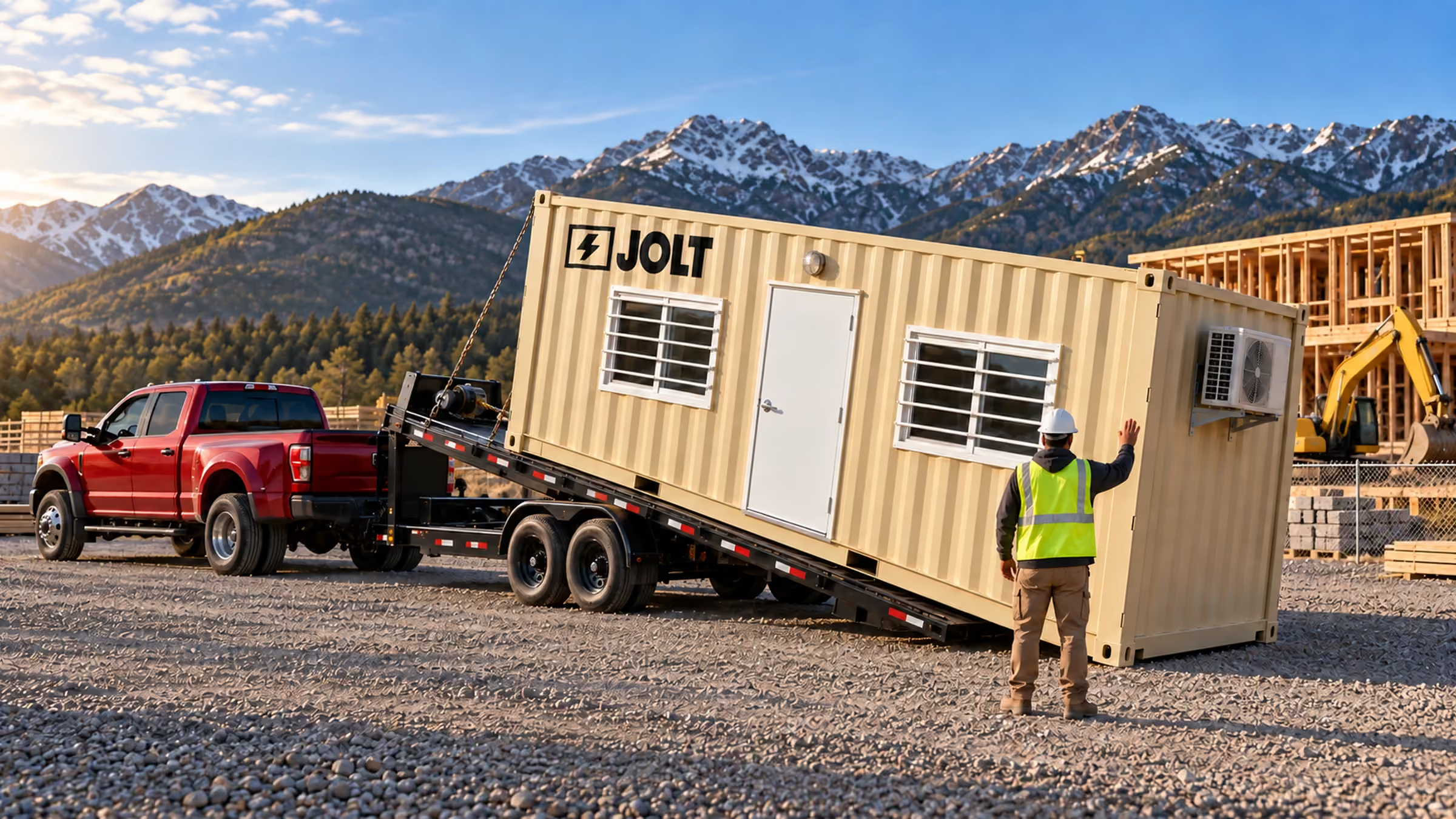
Approval of a use does not prove that a truck can place the box. Rental Agreement §5.2 calls for about 70 ft of straight-line clearance for a 20 ft unit and 100 ft for a 40 ft unit, along with adequate overhead clearance, road width, turning radius and grade.
The pad must be firm, level and well drained. Mark underground utilities, identify overhead lines and branches, and keep a representative on site who can direct the driver to the approved footprint and confirm the door orientation.
JOLT delivers from its Gypsum yard using its own tilt-bed or flatbed truck. Delivery fees follow the address on the pricing schedule and delivery zones; the permit desk does not quote the freight charge or promise that a narrow mountain approach is workable.
Site damage caused by placement at the customer's direction belongs to the customer under §5.4. The customer may not move or lift the unit under §5.5, so plan future excavation, paving, crane operations and winter plowing before the initial set.
The approved location also needs to remain accessible for retrieval. Rental Agreement §16 requires 15 days' written pickup notice, and rent continues until JOLT retrieves the unit.
How should you handle the week before reserving?
Identify the controlling desks
Confirm whether the parcel is inside a municipality or unincorporated county land. Ask planning about zoning or temporary use, building about structural and trade permits, and the road agency about any public-space impact.
Describe one exact use
State storage or occupied office, the 20 ft or 40 ft size, duration, project-permit connection and all utilities. Ask the planner to name the governing section and required application rather than giving only a verbal yes.
Draw the placement and truck path
Put the unit, property lines, access, structures, utilities and parking on a site sketch. Check 70 ft or 100 ft of straight-line delivery clearance and mark the final door direction.
Resolve private approvals
Obtain landlord and HOA consent where applicable under Rental Agreement §5.2(d). Keep that work separate from the public permit because one approval does not replace another.
Match the reservation to the approval
Choose the unit and timing only after the jurisdiction confirms the process. Keep permit conditions, approved plans and site contact information with the superintendent who will meet the driver.
For a Summit County property near Breckenridge, start with the county rule only after confirming the parcel is outside town jurisdiction. For an Eagle County project, call Community Development at 970-328-8730 for the parcel-specific answer.
What should you have ready before you reserve?
Have the parcel address, jurisdiction, written use description, expected duration, active permit number if applicable and the planner's required permit path. Add a site plan showing the approved footprint, 20 ft or 40 ft unit, utility route, truck approach, overhead constraints and final door orientation.
Keep the named site representative, licensed electrician information for an office connection, landlord or HOA consent, and snow-management plan with the field file. Confirm the published monthly rate and delivery charge on the pricing page, then align the standard delivery window with the agency's actual approval rather than an assumed review date.
Questions contractors ask
Does Colorado have one statewide shipping container permit?
No single container rule covers all 64 Colorado counties. Counties and municipalities adopt and enforce building and land-use codes locally, so ask both desks before choosing a placement.
Which permits should I ask about first?
Ask about three subjects: zoning or temporary use, building approval and right-of-way occupancy. The first two usually depend on the county or municipality, while a street placement also involves the agency controlling that street.
Does a temporary construction office need approval in Summit County?
Summit County Land Use and Development Code §3806 provides a temporary-use-permit route for a construction office after a grading or building permit issues. Section 12401 permits may run up to 1 year, and an off-site staging permit under §12401.01 can be renewed annually while the building permit remains active.
Can a 20 ft storage container avoid a Denver building permit?
Denver's residential shed rule does not require a building permit for a 1-story, detached, non-conditioned storage structure up to 200 sq ft and 14 ft tall. A 20 ft container covers 160 sq ft, but zoning approval is still generally required and Former Chapter 59 lots always require it.
Does putting a container in a Denver street require a permit?
Yes, Denver DOTI information sheet DOTIPT-104.1, revised January 30, 2025, requires a Revocable Street Occupancy Permit for a container in the public right-of-way. The container company pulls it, and the sheet says to allow 5 business days.
Who handles permits for a JOLT rental?
The customer handles permits, approvals, zoning, HOA and landlord consents under Rental Agreement §5.2(d). Resolve those items before the standard delivery window because an unsuccessful delivery trip is chargeable under §5.3.
Does a permanent container building follow the same rules as a rental?
Not necessarily, because 2021 IBC §3115 addresses intermodal containers repurposed as buildings or parts of buildings. It calls for verified ISO 6346 plate information, and §3115.8.1 requires engineered foundations and anchorage for permanent container buildings.
Who can answer a permit question in Eagle or Summit County?
Call Eagle County Community Development at 970-328-8730 for an Eagle County address. For Summit County Building Inspection, call 970-668-3170 and identify the parcel, proposed use and placement duration.
Keep reading
- Rent20 ft mobile office — three tiers, one chassis
- Rent20 ft storage container — $295/month, delivered
- LocationJobsite rentals across the Colorado mountains
- LocationJobsite container and office rental in Breckenridge
- GuidePermits for jobsite offices in Eagle County, step by step
- AnswerShipping containers on private property in Summit County
- JOLTPrices. All of them.
- GuideShipping container permits in Colorado — 10 counties and 8 towns in one table
Ready when your site is.
Rentals from $85/mo · every price published
A deposit holds your delivery window. Cancel free of charge more than 14 days before the first day of the window. Deposits from $85 are applied to your first invoice.