

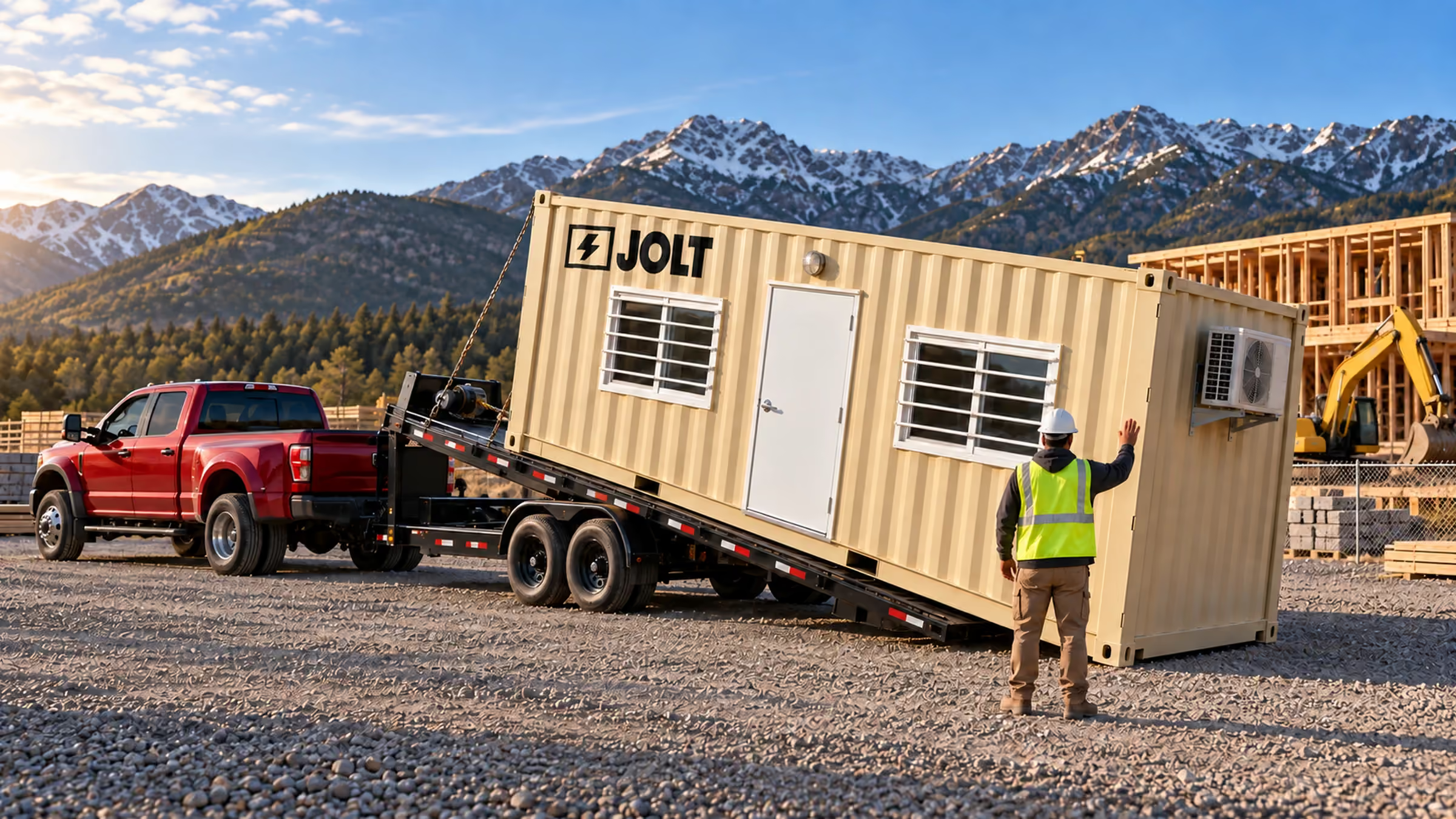
Solutions
Rentals for wildfire & emergency response
Base office Express targets 7 business days; Grid-Free, storage, light and hand-wash support wildfire recovery and rebuild work.
from $295/mo
- 20 ft office
- from $795/mo
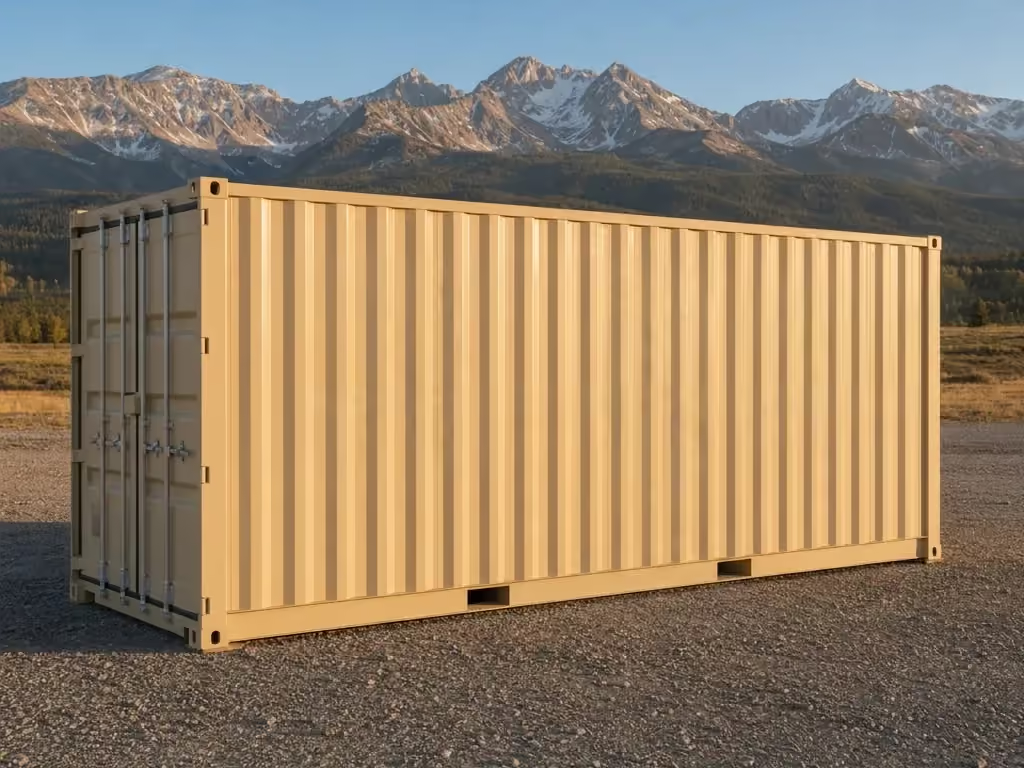
- 20 ft storage
- $295/mo
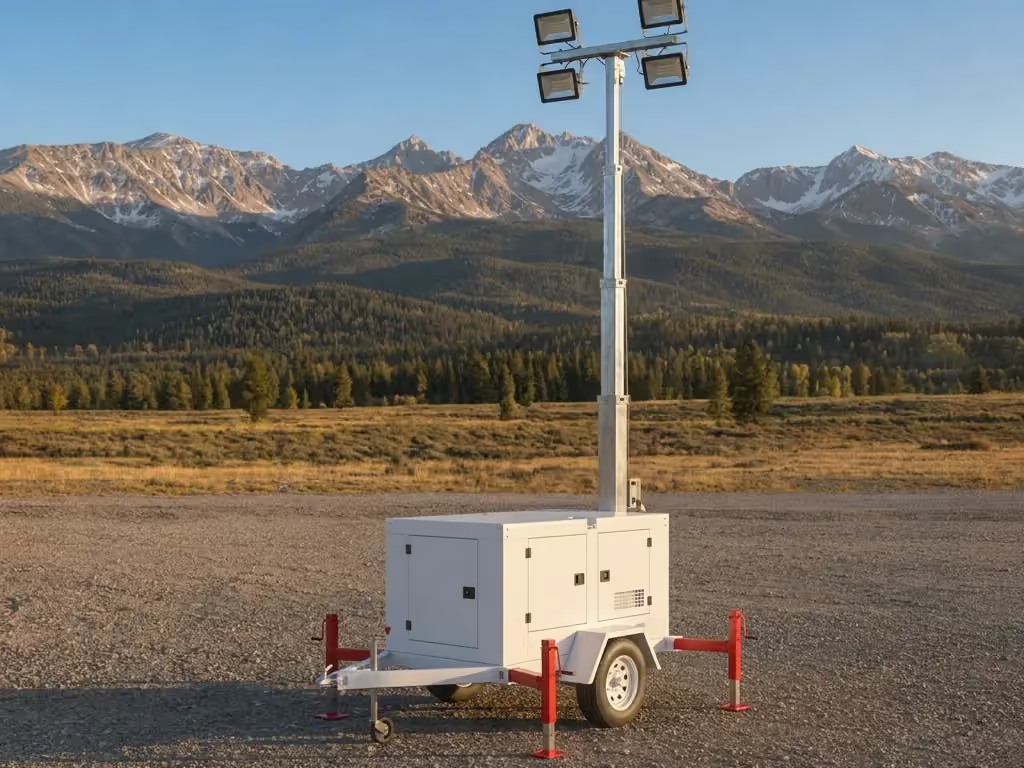
- Light tower
- $1,250/mo
The kit for the job
Key facts
- The Base 20 ft office container rents for $795 per month as of .
- The 20 ft storage container rents for $295 per month as of .
- The Grid-Free 20 ft office container rents for $1,495 per month as of .
- The light tower rents for $1,250 per month as of .
- The hand-wash station rents for $85 per month as of .
Cite this page: "Rentals for wildfire & emergency response." JOLT (Jolt Rents), https://joltrents.com/solutions/wildfire-and-emergency-response. Last updated September 11, 2026.
The core recovery kit is a Base office at $795/mo, a storage container at $295/mo and field equipment chosen for the work area. Where shore power is absent, use the Grid-Free office at $1,495/mo instead of treating a Base office as an off-grid unit.
Emergency response containers in Colorado fit planned staging, debris removal, utility restoration, permit intake and rebuilding. They are not a substitute for the resource systems used during initial attack.
What does a recovery operation need on the ground?
A recovery operation needs distinct places for coordination, protected supplies, sanitation and field support. Match each line to an owner and a work area before reserving; an adjuster team has different power and access needs from a utility crew or debris contractor.
| Unit | Monthly rent | Minimum term | Role in the operation |
|---|---|---|---|
| 20 ft office · Base | $795/mo | 3 months | Recovery-phase office where shore power exists |
| 20 ft office · Grid-Free | $1,495/mo | 3 months | Staging-camp or incident-base office without shore power |
| 20 ft storage | $295/mo | 1 month | Lockable cache for PPE, tools and ordinary supplies |
| Light tower | $1,250/mo | 1 month | Light for night work in the planned operating area |
| Hand-wash station | $85/mo | 1 month | Self-contained hand washing at the compound |
| Temporary fence | $3.50/LF/mo | 1 month | Installed perimeter around a compound or equipment yard |
| Traffic control · Standard | $695/mo | 1 month | Devices for closures and detours under the responsible party's plan |
The Base office has heat, cooling, lights and outlets, but its shore-power inlet must be connected as the Rental Agreement use rules require. Use it for a debris-removal desk, restoration coordination, permit intake or a wildfire recovery office where power is already available. An incident command office rental requested for an active response still has to fit JOLT's availability and delivery window.
The storage unit is a one-trip, standard-height ISO container with cargo doors, a welded lockbox and no windows or man door. It works as a disaster recovery storage container for PPE, tools and ordinary supplies, provided prohibited materials stay out.
The light tower is trailer-mounted, with a mast to about 30 ft and four LED floodlights. The light tower rental and hand-wash station should be placed on the operating plan, not dropped wherever space remains after offices and storage arrive.
What does the kit cost per month?
Build the estimate by address and carry each rented item as its own line. A worked month for a powered recovery site can include:
- Base office monthly rent: $795/mo.
- Express fee for that Base office: $750.
- 20 ft storage monthly rent: $295/mo.
- Light tower monthly rent: $1,250/mo.
- Hand-wash station monthly rent: $85/mo.
- Temporary fence, 300 LF: $3.50/LF/mo.
- Fence installation: $1.75 per linear foot.
- Fence removal: $1.75 per linear foot.
- Traffic control Standard package: $695/mo.
The reservation lines are the Base office deposit at $750, storage deposit at $350, light tower deposit at $500, hand-wash deposit at $85, fence deposit at $500 and traffic-control deposit at $350. A deposit reserves that equipment and its delivery window and applies to the first invoice.
A Boulder operation is Zone E — $1,200 each way for each unit. A Glenwood Springs operation is Zone B — $550 each way for each unit. Delivery and pickup are separate lines on each unit's invoice.
Add the 5% environmental fee and sales tax. Then select either the damage waiver at 12% of rent and recurring upgrades, or the refundable deposit of one month's rent plus a certificate of insurance. The insurance terms and damage-waiver terms govern those choices.
Office rentals carry a 3-month minimum. Storage, fence and equipment carry a 1-month minimum, then rentals continue month to month until retrieval. Use how JOLT rentals work to set the reservation, access and pickup dates around the field schedule.
Where does JOLT fit in the incident timeline?
Initial attack is resourced through the agencies' own systems. JOLT is not on an agency contract, dispatch list or resource-order list unless your organization knows otherwise, so ask before writing our equipment into an initial-attack plan.
The practical windows are pre-season staging, the recovery phase and the rebuild. A county emergency manager might reserve a supply cache before seasonal operations, while a utility might place a Base office after shore power is restored. Debris-removal contractors, permit teams and insurers' catastrophe teams can use offices during the longer recovery period.
In Boulder County, work following the 2021 Marshall Fire is an example of the recovery and rebuild phase rather than initial attack. The right question for a Boulder delivery is whether the requested unit and arrival window fit a defined recovery task.
The 2020 Grizzly Creek Fire closed Interstate 70 through Glenwood Canyon, according to the Colorado Department of Transportation, which is why access is an operating condition rather than a formality. For a Glenwood Springs assignment, confirm the current route, turning space and placement area before our truck leaves the yard.
Public buyers should also review the municipal and government rental process. That process covers how an agency pays; it does not change the equipment's response role or delivery window.
How does a camp without power work?
Use Grid-Free when the assigned office area lacks shore power. It includes WATCH, CONNECT and POWER, plus a 10 kWh battery pack that runs the office HVAC. The separate off-grid office power answer explains why the Base office and Grid-Free office are not interchangeable.
WATCH is a solar LTE panoramic camera with motion alerts and cloud clips. The WATCH details matter when the office overlooks stored equipment or an access point, but the customer remains responsible for required recording notices, signage and consents.
CONNECT uses Starlink and a router. Starlink and LTE depend on sky view, terrain, weather and network conditions, and solar performance depends on sunlight and load. JOLT does not promise uptime, speed, coverage, capacity or availability under Rental Agreement §13.
Place the Grid-Free office where its systems have a useful sky view and where the delivery route remains open for retrieval. Do not put it under a plan that assumes communications will stay available regardless of terrain or smoke conditions.
Set the light tower where the responsible operations lead wants illumination and where trained personnel can operate it under its instructions. The customer supplies its fuel and must return it at the delivered fuel level. Confirm fuel details for the assigned unit when you reserve.
Put the hand-wash station inside the managed staging compound. It is self-contained with its own water supply, while the customer provides water, soap and towels. It is not freeze-proof, so the site team must account for conditions during a cold-weather recovery.
Offices are workspaces, not quarters. No one may live or sleep overnight in an office, storage container or other rented unit under Rental Agreement §7. Arrange lodging separately from the staging layout.
How are fence and traffic devices used?
Temporary fence can define a staging compound, separate a tool cache or mark the edge of an equipment yard. JOLT installs the agreed line at $1.75 per linear foot and removes it at $1.75 per linear foot.
The published fence has galvanized chain-link panels that are 6 ft tall by 10 ft wide, with steel tube stands and clamps. No gates, windscreen or privacy screen are included. Nothing may be attached to the panels without JOLT's written consent.
Mark apparatus routes, worker entries and equipment openings on the site plan before the fence layout is set. The jobsite security answer can help the responsible team place a container and perimeter as parts of one access-control plan.
Traffic control rental supplies equipment only. The Standard package has 50 cones, 10 Type III barricades, 8 vertical panels, 4 sign stands and 2 flagger paddles; Basic and Full packages are also available for a different device count.
The agency or contractor decides the traffic-control plan and provides the personnel who place and operate the devices. JOLT supplies no flaggers and writes no traffic-control plan. For a closure or detour, reserve the package only after the responsible party has selected the devices its plan requires.
If WATCH is needed, put it on an office or storage unit with a useful view of the controlled area, and plan the recording notices with the agency before the camera goes live.
Who carries the fire risk?
The customer bears the risk of loss, theft, damage or destruction from delivery until JOLT retrieves the equipment. That allocation includes fire under Rental Agreement §8, even when the equipment is idle or the work area has been evacuated.
The optional damage waiver covers accidental damage subject to its deductible and exclusions. It excludes theft, unauthorized relocation, prohibited use, neglect, vandalism and other listed events, so read Rental Agreement §12 before selecting it. The alternative is a refundable deposit of one month's rent plus the certificate of insurance required by Rental Agreement §10.
Keep hazardous, flammable, explosive and corrosive material out of and away from every unit. That restriction applies to the storage cache as well as the office, fence and field equipment. Fuel for the light tower remains the customer's responsibility, but it must be managed without violating the no-flammable-material rule around rented equipment.
Assign one person to inspect rented equipment and report damage, malfunction, leakage or loss. The same person should make sure access remains open, debris stays clear of the units and the fuel level is documented for return.
The customer may not move a container, lift a unit or tow rented equipment to another site without JOLT's prior written consent. If an operational perimeter changes, ask before treating a rented unit as a movable response asset.
What can JOLT actually promise on speed?
Express targets 7 business days for the Base office and costs $750. It is available only for the Base tier and remains subject to the availability shown by the live badge on the Base office details.
If JOLT misses the Express target, the remedy is limited to the Express fee under Rental Agreement §5. Express does not change site-access duties, waive the deposit or turn another office tier into an expedited unit.
Every other unit uses the 2–4 week window from reservation. That includes Grid-Free, storage, light towers, hand-wash stations, fence and every traffic-control package. An Express office can arrive on its target while the rest of the compound remains on the standard schedule.
There is no published emergency pricing, standby contract or after-hours rate. The published rate is the rate, so ask before assuming a unit, dispatch relationship or service outside the stated offer. Availability can change while an incident develops.
The honest planning advice is to reserve for the phase the window fits. Pre-season staging can use the normal window; a recovery office with shore power can use Express when Base availability is shown; an immediate tactical need should stay within the responsible agency's established system.
What do the delivery zones change?
All equipment leaves our yard in Gypsum. Eagle and Gypsum are Zone A, Glenwood Springs is Zone B, Steamboat Springs is Zone D, and Boulder, Golden and Evergreen are Zone E. Golden, Evergreen and Boulder represent foothills wildland-urban interface destinations, but the zone changes transport pricing rather than the customer's siting duties.
| Zone | Towns | Delivery | Pickup |
|---|---|---|---|
| Zone A | Gypsum, Eagle, Edwards, Avon, Beaver Creek | $400 | $400 |
| Zone B | Vail, Minturn, Glenwood Springs | $550 | $550 |
| Zone C | Breckenridge, Frisco, Silverthorne, Keystone, Carbondale, Basalt, Aspen, Snowmass | $750 | $750 |
| Zone D | Steamboat Springs, Leadville, Grand Junction | $950 | $950 |
| Zone E | Idaho Springs, Georgetown, Evergreen, Golden, Morrison, Lakewood, Arvada, Aurora, Centennial, Littleton, Boulder, Castle Rock, Denver | $1,200 | $1,200 |
| Zone F — Mountain West12-month minimum | WY, ID, UT, MT | $1,795 | Pickup quoted separately before delivery |
For a 20 ft container, the customer provides a firm, level, well-drained placement area and about 70 ft of straight-line truck clearance. The route also needs adequate overhead clearance, road width, turning radius and grade, with utilities located and permits or landowner consents in place. A representative must be present for placement under Rental Agreement §5.
Check the delivery-zone schedule and send the exact address before building the estimate. Each unit carries its own delivery and pickup lines, even when several agencies share one compound.
Reserve each unit against the phase when its placement pad and route will be ready. A storage cache can arrive before an office if its area is accessible, while fence installation should follow a current drawing that preserves apparatus and delivery routes.
What does a road closure or evacuation do to the schedule?
Fire, road closures and government action are force-majeure events under Rental Agreement §23. Delivery or pickup can shift when those events prevent safe access, and JOLT is not liable for the resulting delay or failure.
An evacuation does not end the rental period. Rent continues until JOLT retrieves the equipment, so the demobilization plan should include written pickup notice and a route our truck can actually use. If officials restrict entry, tell JOLT before scheduling the retrieval trip.
A failed delivery caused by site conditions, access, weather or an absent representative is charged under Rental Agreement §5. A failed pickup caused by site access or equipment not being ready is also charged, and rent continues until retrieval.
Do not send our truck toward a closure on the assumption that local access will be granted. Confirm the route with the responsible road authority, identify an authorized site representative and report changed conditions before dispatch.
Recovery plans should carry an alternate placement date and a retrieval decision point. That keeps a road closure from turning into an avoidable failed trip while preserving the agency's control over evacuation and re-entry decisions.
Questions contractors ask
What is the fastest an office can arrive?
JOLT Express targets 7 business days on the Base office for $750, subject to availability. Every other unit uses the 2–4 week delivery window.
Can crews sleep in a rented unit?
No. A rented unit cannot be used as a residence or for overnight sleeping.
How does an incident base without power get an office?
The Grid-Free office is $1,495/mo with a 3-month minimum. Its built-in WATCH, CONNECT and POWER systems include a 10 kWh battery pack that runs the HVAC.
What does the light tower need?
The customer supplies fuel and returns the tower at the delivered fuel level. Rent is $1,250/mo.
What does a supply cache cost?
A 20 ft storage container is $295/mo with a 1-month minimum and a $350 reservation deposit.
What does fence around a staging compound cost?
Fence is $3.50/LF/mo, with $1.75/LF installation and $1.75/LF removal. The reservation deposit is $500.
Who carries fire risk on a rented unit?
The customer carries risk from delivery through retrieval. The damage waiver is 12% of rent, or the customer can provide a deposit of one month's rent plus a certificate of insurance.
Does JOLT have emergency pricing or standby contracts?
None are published. The published rate is the rate, so ask about the current fit before making a response plan.
Keep reading
- RentBase: the office that shows up and works
- RentHand-wash stations
- RentTraffic control packages for road and ROW work
- AnswerPowering a jobsite office with no hookup: solar, battery, generator compared
- LocationJobsite rentals in Boulder — from our I-70 yard
- LocationJobsite container and office rental in Glenwood Springs
- Rent20 ft mobile office — three tiers, one chassis
- RentGrid-Free: drop it anywhere. It runs itself.
Reserve it today.
Rentals from $85/mo
A deposit holds your delivery window. Cancel free of charge more than 14 days before the first day of the window. Deposits from $85 are applied to your first invoice.