
Guide
Shipping container permits in Colorado — 10 counties and 8 towns in one table

Quick answer
Colorado has no statewide permit for a shipping container. Each of the 18 jurisdictions below adopts its own code, and the answer turns on where the box sits: an active jobsite, a private lot or a public street. Summit County requires a temporary use permit for a construction office, Glenwood Springs caps a site at 1,000 sq ft of containers, Denver allows 180 days on a street, and 7 of the 18 desks publish no rule that reaches a container.
Key numbers
| What | Figure |
|---|---|
| Jurisdictions in the table10 counties and 8 towns, each with a phone number | 18 |
| Glenwood Springs container capof containers per site, each at most 10 ft tall and never stacked, §070.030.040(d)(4) | 1,000 sq ft |
| Footprint of a 20 ft containerabove the 120 sq ft shed exemption in Grand, Boulder and Eagle counties | 160 sq ft |
| Denver street placementmaximum in any 12-month period under DOTIPT-104.1 | 180 days |
| Denver corner clearancefrom any corner, alley or entrance, in a parking lane | 20 ft |
| Summit County construction officeremoved after 180 days of suspended work; temporary use permit needed, LUDC §3806 | 180 days |
| Crested Butte right-of-way seasonright-of-way permits are approved for May through October only | 6 months |
| Free cancellationcancel more than 14 days before the delivery window if the permit falls through | 14 days |
Catalog figures as of — the same ones the Price Book publishes.
Cite this page: "Shipping container permits in Colorado — 10 counties and 8 towns in one table." JOLT (Jolt Rents), https://joltrents.com/shipping-container-permits-colorado. Last updated September 13, 2026.
A shipping container permit in Colorado is decided at the county or town desk, never by the state. This guide puts 10 counties and 8 mountain towns in one table with what each one publishes about a container: whether a permit is needed, how long the box may stay, where it may sit, what the snow-load note says and who answers the phone. Every sourced cell links its page and section, and where a desk publishes nothing the cell says so and gives the number.
The table covers a rented box, which is temporary equipment on somebody else's permit path. A container converted into a permanent building follows a longer road, and the Colorado permit answer covers that distinction and the three permit families in general terms.
Which question decides the permit: site, lot or street?
Three placements produce three different conversations, and the desk needs to hear which one you mean in the first sentence. The 18 jurisdictions below publish different rules, and every desk that publishes one sorts a container by where it sits and for how long.
An active construction site
On a site with an open building permit, a storage container or a site office is accessory to the work already approved. Summit County makes that explicit: construction offices are allowed in any zoning district with a temporary use permit, and the office leaves at the final certificate of occupancy or after 180 days of suspended work under LUDC §3806 and §3806.01. Avon exempts construction trailers and stored equipment on a property with a valid building permit from its temporary use permit under Development Code §7.24.080(f), and Glenwood Springs lets a portable storage container sit on a construction site until the certificate of occupancy or the permit's expiry, whichever comes first, under Municipal Code §070.030.040(d)(4). The other desks publish no rule that reaches a container on a permitted site; the table says which ones, and each of those rows carries the number to confirm with.
The 2021 International Building Code treats a structure erected for less than 180 days as temporary under Section 3103, and Section 3103.1.2 requires a permit from the building official for a temporary structure that covers more than 120 sq ft (the section's own words add "including connecting areas or spaces with a common means of egress or entrance that are used or intended to be used for the gathering together of 10 or more persons"). A 20 ft office covers 160 sq ft, so under the model code it is over the threshold. Whether a locked storage box that nobody works inside is read the same way is the desk's call, and only the desk can make it.

A private lot for the long term
A container on a residential or commercial lot with no construction underway is a zoning question first. Grand County, Boulder County and Glenwood Springs exempt a one-story detached accessory building of 120 sq ft or less from a building permit, and Denver's residential shed rule stops at 200 sq ft. A 20 ft box covers 160 sq ft, so it fits inside Denver's shed exemption and outside the other 3, and in all 4 the zoning review is separate from the building permit.
Glenwood Springs is the 1 jurisdiction of the 18 that publishes a placement rule for a container on a lot: rear or side of the principal building, at most 10 ft tall, never stacked, no more than 1,000 sq ft of containers on the site, and screened where a street or a residence can see it (Municipal Code §070.030.040(d)(4)). The other 17 publish no rule written for containers, so the question for a box on a lot there is whether the district's general rules for accessory structures or outdoor storage reach it, and that is the zoning desk's call, not a lookup in this table. Summit County shows what such a rule looks like: its residential outdoor-storage section puts stored goods in a side or rear yard and asks for screening on the smaller lots, without naming containers, and this guide has not confirmed whether the county treats every personal storage box as stored equipment; the Summit County answer walks through it and it applies only outside the towns.
A public street or right-of-way
A container in a street, an alley or a sidewalk zone is a right-of-way question, and where the table shows a route into the right-of-way it is an approval separate from the building permit. Denver publishes the most complete rule, 4 mountain towns publish an approval, a license or a season, and Douglas County keeps roll-off containers off public roads entirely. The street section below covers each one; the point here is that a street placement needs its own application, or is not offered at all, even when the lot next to it needs nothing.
What do the 10 counties actually publish?
Each row below is what the county or town publishes on its own site, with the page and section linked. Where a desk publishes no container rule, the cell says "confirm with the building department" and gives the number rather than guessing. Summit County's construction-office rule appears only in the Summit County row, because it is a county land use code that stops at each town boundary.
How we built this table: Every cell comes from the jurisdiction's own site or code, fetched and read on September 13, 2026, and each is linked to its page and section. A cell that says "confirm with the building department" means 2 searches and 2 page reads found no published rule; nothing in the table is inferred from a neighboring county.
| Jurisdiction | Permit needed? | Duration limit | Setback or placement | Snow-load note | Who to call |
|---|---|---|---|---|---|
| Eagle County (unincorporated) | The shed exemption stops at 120 sq ft and a 20 ft box covers 160 sq ft; the Building Resolution's permit matrix lists moving and setting a factory-built structure as permitted work (Eagle County guide, Table 1). The division permits and inspects unincorporated land only (Building FAQ). | No published duration rule; confirm with the building department at 970-328-8761. | No published container setback; confirm with the building department at 970-328-8761. | Building Resolution Section 1608.2 as amended: design snow loads follow the 2016 Colorado Ground Snow Map or 2016 Colorado Design Snow Loads by the Structural Engineers Association of Colorado (Building FAQ, snow load question). | Eagle County Building Division, 970-328-8761 (contact page). Codes in effect: 2021 I-Codes and 2023 NEC. |
| Summit County (unincorporated) | Construction offices are allowed in any zoning district with approval of a temporary use permit (LUDC §3806). Residential storage rules are in the Summit County answer. | The office is removed at the certificate of occupancy for the final phase, or when work is suspended or abandoned for 180 calendar days (LUDC §3806.01). | No published container setback beyond the residential storage rules; confirm with the building department at (970) 668-3170. | No published countywide figure; confirm with the building department at (970) 668-3170. | Summit County Building Inspection, (970) 668-3170 (department page). Codes in effect: 2024 I-Codes (Resolution 2026-45). |
| Pitkin County (unincorporated) | No published container rule; confirm with the building department at 970-920-5200. | No published duration rule; confirm with the building department at 970-920-5200. | No published container setback; confirm with the building department at 970-920-5200. | No published countywide figure; confirm with the building department at 970-920-5200. | Pitkin County Community Development, Building, through the county line 970-920-5200 (Building page). Codes in effect: 2021 International Building Code series, effective January 30, 2023. |
| Garfield County (unincorporated) | No published container rule; confirm with the building department at (970) 945-8212. | No published duration rule; confirm with the building department at (970) 945-8212. | No published container setback; confirm with the building department at (970) 945-8212. | The county's residential requirements sheet prints roof snow loads, not a single ground value; ask which applies to the parcel (Building requirements, residential projects). | Garfield County Community Development, (970) 945-8212 (printed on the residential requirements sheet). Reference codes on that sheet: 2015 IRC, IBC, IFC, IFGC, IMC and IPC. |
| Routt County (unincorporated) | No published container rule; confirm with the building department at (970) 870-5566. | No published duration rule; confirm with the building department at (970) 870-5566. | No published container setback; confirm with the building department at (970) 870-5566. | No single published figure; confirm with the building department at (970) 870-5566. | Routt County Regional Building Department, (970) 870-5566 (department page); the same office serves Steamboat Springs. |
| Grand County (unincorporated) | A one-story detached accessory building of 120 sq ft or less used as a storage shed needs no building permit (Building FAQ, 'What work can I do without a permit?'); a 20 ft box covers 160 sq ft. | No published duration rule; confirm with the building department at 970-725-3255. | No published container setback; confirm with the building department at 970-725-3255. | The design snow load varies by elevation and location, and the department gives the value for the parcel (Building FAQ, snow load question). | Grand County Building and Sanitation, 970-725-3255 (department page). |
| Jefferson County (unincorporated) | No published container rule; confirm with the building department at 303-271-8260. | No published duration rule; confirm with the building department at 303-271-8260. | No published container setback; confirm with the building department at 303-271-8260. | No published countywide figure; confirm with the building department at 303-271-8260. | Jefferson County Building Safety, 303-271-8260 (adopted building codes). The 2024 building codes apply to permits applied for on or after July 1, 2026. |
| Denver (city and county) | No building permit for a one-story, detached, non-conditioned storage structure of 200 sq ft or less (Residential sheds); zoning review is separate. A construction office follows the temporary use route in the Denver answer. | In the public right-of-way, 180 days at most within any 12-month period (DOTIPT-104.1, Placement). | In the right-of-way, inside a parking lane and at least 20 ft from any corner, alley or entrance; never on a sidewalk, tree lawn or travel lane (DOTIPT-104.1, Placement). | No published figure on the shed or container pages; confirm with the building department at 720-865-2700. | Denver Community Planning and Development, 720-865-2700 (contact page); street permits through DOTI Permit Operations, (303) 446-3759 (right-of-way permits). Codes in effect: 2025 Denver Building and Fire Code. |
| Boulder County (unincorporated) | Exempt from a building permit when the floor area of the structure does not exceed 120 sq ft (Building Permit Requirements B05, 'Work Exempt from a Building Permit'); a 20 ft box covers 160 sq ft. | No published duration rule; confirm with the building department at 303-441-3930. | No published container setback; confirm with the building department at 303-441-3930. | Snow loads are read from the county's map for the parcel; confirm with the building department at 303-441-3930. | Boulder County Community Planning and Permitting, 303-441-3930 (building page). Codes in effect: 2021 IBC and IRC with county amendments (B05). |
| Douglas County (unincorporated) | No published container rule; confirm with the building department at 303-660-7497. | No published duration rule; confirm with the building department at 303-660-7497. | Trash dumpsters and roll-off containers are not permitted on any public road (Building permits notice); no published setback for a storage container on the lot. | No published countywide figure; confirm with the building department at 303-660-7497. | Douglas County Building Division, 303-660-7497 (adopted building codes). |
| Vail (town) | No published container rule; confirm with the building department at 970-479-2139. The town, not Eagle County, permits inside town limits (Eagle County Building FAQ). | No published duration rule; confirm with the building department at 970-479-2139. | No published container setback; confirm with the building department at 970-479-2139. | No published town figure on the code pages; confirm with the building department at 970-479-2139. | Town of Vail Building Department, 970-479-2139 (department page). Codes in effect: 2024 International Building Code and Residential Code since January 1, 2025 (recent code amendments). |
| Avon (town) | A temporary use permit is required for a temporary structure, and the code's list of temporary structures includes an office and a manufactured or mobile unit (Development Code §7.24.080(b) and (e)). Construction trailers and stored equipment on a property with a valid building permit are exempt (§7.24.080(f)). The town, not Eagle County, permits inside town limits. | An administrative temporary use permit covers a use or structure of at most 30 days in a calendar year and runs no longer than 1 year; past 30 days the Planning and Zoning Commission decides after a public hearing (§7.24.080(d)). | No published container setback; the review criteria require a temporary structure to be anchored and to meet the Building Official's requirements (§7.24.080(h)). Confirm the placement with the building department at 970-748-4030. | Minimum roof snow load of 75 psf at or below 8,200 ft and 90 psf above, with a 48 in frost depth and a 115 mph wind speed (adopted building codes, Adopted Standards); Municipal Code §15.08.110 writes the same 2 figures into Section 1608.2 (§15.08.110). | Town of Avon Building Division, 970-748-4030 (Building page). Codes in effect: 2021 International Building Code and Residential Code (adopted building codes). |
| Aspen (city) | No published container rule; confirm with the building department at 970-920-5090. | No published duration rule; confirm with the building department at 970-920-5090. | Field offices and similar items may not be placed in the public right-of-way without prior approval of the City Engineer (Municipal Code §21.04.060). | No published city figure; confirm with the building department at 970-920-5090. | City of Aspen Building Department, 970-920-5090 (department directory). |
| Glenwood Springs (city) | The Development Code regulates portable storage containers by name: on a construction site with an unexpired building permit a container may sit as storage incidental to the work (Municipal Code §070.030.040(d)(4)); elsewhere it is an accessory use where Table 030.1 allows it. Any other temporary structure needs a temporary use permit approved before it is set (§070.030.050(c)). The shed exemption stops at 120 sq ft (Building FAQ). | A construction-site container is removed once the certificate of occupancy is issued or the building permit expires, whichever comes first (§070.030.040(d)(4)). A temporary use permit runs at most 14 consecutive days and renews up to 3 times in a calendar year (§070.030.050(d)). | Rear or side of the principal building; never in circulation aisles, fire lanes, easements or public rights-of-way, in a parking area only where no required space is taken, and never in required landscaping or common open space; at most 10 ft tall, never stacked, and no more than 1,000 sq ft of containers on a site; a 6 ft opaque, year-round fence, wall or berm where a street or a customer parking area can see the box or a lodging or residential use adjoins it (§070.030.040(d)(4), Location, Number and Size, Screening). | The Building Department's design criteria sheet lists a 50 psf ground snow load and a 36 in frost depth (Climatic and Geographic Design Criteria, Table R301.2(1)); the sheet predates the 2021 codes, so confirm the current figure with the building department at 970-384-6450. | City of Glenwood Springs Building Department, 970-384-6450 (department page). Codes in effect: 2021 International Building Code and Residential Code, required for permits since June 6, 2022. |
| Breckenridge (town) | No published container rule; confirm with the building department at 970-453-3180. Inside town limits the town permits, not Summit County. | No published duration rule; confirm with the building department at 970-453-3180. | A right-of-way permit is required for construction, encroachment or staging in town right-of-way (Engineering permits, Right-of-Way Permit). | No published town figure on the code pages; confirm with the building department at 970-453-3180. | Town of Breckenridge Building Division, 970-453-3180 (department page). Codes in effect: 2024 IBC and IRC (adopted building codes). |
| Steamboat Springs (city) | No published container rule; confirm with the building department at (970) 870-5566. Permits run through the Routt County Regional Building Department (City of Steamboat Springs). | No published duration rule; confirm with the building department at (970) 870-5566. | No published container setback; confirm with the building department at (970) 870-5566. | No single published figure; confirm with the building department at (970) 870-5566. | Routt County Regional Building Department, (970) 870-5566 (City of Steamboat Springs page). Codes in effect: ICC 2021 editions under the city's building code ordinance. |
| Telluride (town) | No published container rule; confirm with the building department at (970) 728-2175. | No published duration rule; confirm with the building department at (970) 728-2175. | No published container setback; confirm with the building department at (970) 728-2175. | No published town figure; confirm with the building department at (970) 728-2175. | Town of Telluride Planning and Building, (970) 728-2175 (department directory). |
| Crested Butte (town) | No published container rule; confirm with the building department at 970-349-5338. | Right-of-way permits are approved for May through October only, and use of the right-of-way in the other months is prohibited (Licensing and permitting, Right of Way Permit Application). No published limit on private lots. | Field offices and similar items may not be placed in the public right-of-way without prior approval of the Town Manager (Municipal Code §11-1-30). | No published town figure; confirm with the building department at 970-349-5338. | Town of Crested Butte, 970-349-5338 (town directory); ask for the Building Official. |
Where a county publishes a container rule
Five of the 10 counties publish something a container fits into. Summit County's construction-office rule under LUDC §3806 is the only one written for a jobsite office, and its 180-day suspension clock is the only duration limit any county states for private land. Eagle County's permit matrix reaches a factory-built structure, Grand County and Boulder County publish the 120 sq ft shed exemption that a 20 ft box exceeds, and Denver publishes both a 200 sq ft shed exemption and a complete street rule.
Among the 10 counties only Denver's street sheet uses the word "container", and 3 of the 5 rules are exemptions rather than permissions. An exemption from the building permit leaves the zoning question open, which is why the Denver and Boulder rows both send you back to the desk for the placement itself.
Where the answer is a phone call
Pitkin, Garfield, Routt and Jefferson counties publish their adopted codes, their fee schedules and their contact numbers, and nothing about a container; Douglas County adds only its road rule for trash dumpsters and roll-offs. That is not a gap in the research; it is where the published material stops, at the code edition and the phone number, so the placement itself is a call to the desk. Jefferson County moved to the 2024 building codes for permits applied for on or after July 1, 2026, Pitkin County has run the 2021 series since January 30, 2023, and Garfield County's residential sheet still lists the 2015 editions.
The code edition matters because it sets the snow, wind and frost numbers a permitted office is checked against, and those differ between a 2015 and a 2024 adoption. When you call one of these 5 counties, ask 3 things: whether the placement needs zoning review, whether a building permit applies to the size and use, and what design snow load the parcel carries.
Eagle County in detail
Eagle County is JOLT's home county, and the Eagle County permit guide walks the process step by step: the Building Resolution's 115 mph wind speed, 48 in frost depth and seismic category C, the 120 sq ft shed exemption a 20 ft box exceeds, and the permit matrix entry for moving and setting a factory-built structure. The county's own FAQ adds that its Building Division permits and inspects unincorporated land only, so an address in Vail, Avon, Eagle or Gypsum belongs to the town.
Snow load in Eagle County is a map lookup, not a countywide number. The Building Resolution's amended Section 1608.2 sends design snow loads to the 2016 Colorado Ground Snow Map or the 2016 Colorado Design Snow Loads by the Structural Engineers Association of Colorado (Building FAQ), so the inspector reads the parcel's elevation before quoting a figure. JOLT publishes no snow-load rating for any unit; the design check is the engineer's and the county's.
How do the 8 mountain towns differ from their counties?
A town inside a county takes its own applications, adopts its own code edition and may write its own right-of-way rule. The Eagle County FAQ says it directly for Vail, Avon, Eagle, Gypsum, Minturn, Red Cliff and Basalt: the county processes permits for unincorporated land only, and each town takes its own applications. The same split holds for Aspen, Glenwood Springs, Breckenridge, Telluride and Crested Butte, which is why Summit County's construction-office rule does not appear in the Breckenridge row; Steamboat Springs is the exception, sharing one regional desk with Routt County.
Vail, Avon and Eagle County
Vail adopted the 2024 International Building Code and International Residential Code effective January 1, 2025 (recent code amendments), 1 edition ahead of the county's 2021 adoption. The town publishes no container rule, so a placement inside town limits starts with the Building Department at 970-479-2139 and a description of the site, the use and the duration.
For a Vail project, the county's snow map still describes the terrain, but the town's inspector applies the town's code. Ask which design snow load the town assigns to the address rather than carrying a county figure across the boundary.
Avon, Vail's neighbor in Eagle County, publishes the most complete temporary-structure rule of the 8 towns. A temporary use permit is required for a temporary structure, and the code's own list of temporary structures includes an office and a manufactured or mobile unit under Development Code §7.24.080(b) and (e); construction trailers and stored equipment on a property with a valid building permit are exempt under §7.24.080(f). An administrative permit covers at most 30 days in a calendar year and runs no longer than 1 year, and past 30 days the Planning and Zoning Commission decides after a public hearing (§7.24.080(d)). A construction trailer or stored equipment on a permitted jobsite is the exempt case; a box on a lot with no building permit is the 30-day case, and the desk at 970-748-4030 can say which case a box in a given use is.
Avon also publishes its design numbers where the county publishes a map: a minimum roof snow load of 75 psf at or below 8,200 ft and 90 psf above it, a 48 in frost depth and a 115 mph wind speed (adopted building codes, Adopted Standards). The town's snow-load elevations map on the same page decides which figure a parcel carries.
Aspen and Pitkin County
Aspen's published rule is about the street, not the lot: field offices and similar items may not be placed in the public right-of-way without prior approval of the City Engineer under Municipal Code §21.04.060. On a private parcel inside the city, the Building Department at 970-920-5090 is the desk; outside the city, Pitkin County's line at 970-920-5200 is.
Both desks publish the 2021 code series; the snow-load figure still comes from each desk's own amendments and the parcel's elevation, so it is confirmed per address, not per boundary. The Aspen location page covers the delivery side of a Roaring Fork placement, including the Zone fee for the address.
Glenwood Springs and Garfield County
Glenwood Springs is the 1 desk in the table that regulates portable storage containers by name. Under Municipal Code §070.030.040(d)(4) a container may sit on a construction site as storage incidental to the work while the building permit is open, and it leaves once the certificate of occupancy is issued or the permit expires, whichever comes first. Outside a project a container is an accessory use where Table 030.1 allows it: at the rear or side of the principal building, off circulation aisles, fire lanes, easements and public rights-of-way, at most 10 ft tall, never stacked, and no more than 1,000 sq ft of containers on a site, which is 6 of the 20 ft boxes or 3 of the 40 ft. Where a street, a customer parking area or a residence can see the box, the code asks for a 6 ft opaque fence, wall or berm.
Any other temporary structure needs a temporary use permit approved before it is set, and that permit runs at most 14 consecutive days with up to 3 renewals in a calendar year (§070.030.050). The city's Building Department at 970-384-6450 has required the 2021 codes since June 6, 2022, and its design criteria sheet lists a 50 psf ground snow load and a 36 in frost depth; the sheet predates that adoption, so ask the desk for the current figure. Outside city limits, Garfield County's line at (970) 945-8212 is the desk, and the county publishes no container rule at all.
Breckenridge and Summit County
Breckenridge permits inside town limits under the 2024 International Building Code and International Residential Code (adopted building codes), and its engineering desk requires a right-of-way permit for construction, encroachment or staging in town right-of-way (engineering permits, Right-of-Way Permit). Summit County's LUDC, including the construction-office rule, governs unincorporated land only, so a Breckenridge address does not get a county temporary use permit.
The practical test is the parcel's jurisdiction, not the mailing address. Many "Breckenridge" addresses sit outside town limits, and those follow the county rules in the Summit County answer; the town's building division at 970-453-3180 can say which side of the line a parcel is on.
Steamboat Springs, Telluride and Crested Butte
Steamboat Springs runs its permits through the Routt County Regional Building Department at (970) 870-5566, and the city's building code ordinance adopts the ICC 2021 editions (City of Steamboat Springs). One desk covers the city and the county, which removes the boundary question but not the container one, because neither publishes a container rule.
Telluride's Planning and Building Department at (970) 728-2175 publishes no container rule either. Crested Butte publishes 2: field offices may not be placed in the right-of-way without the Town Manager's approval under Municipal Code §11-1-30, and right-of-way permits are approved for May through October only (licensing and permitting). A Crested Butte street placement in the other 6 months is not a permit question; it is prohibited.
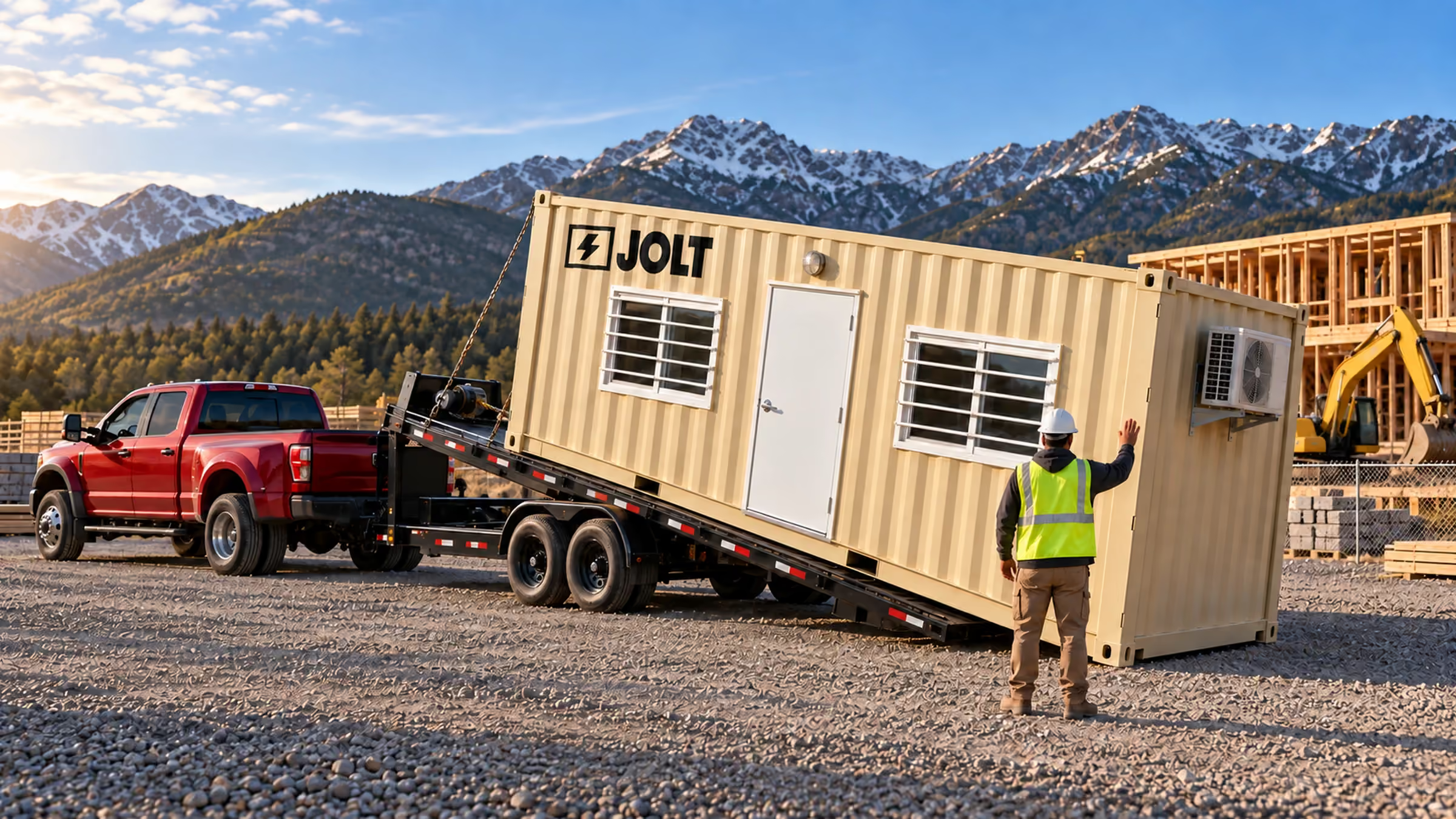
What happens when the container sits on a public street?
A street placement is where the published rules cluster, because a road authority regulates the right-of-way whether or not the zoning code mentions a container. The rules below are the ones the 18 desks publish; a container on private land behind the property line is outside all of them.
Denver's 180-day street rule
Denver's information sheet DOTIPT-104.1 covers dumpsters, roll-offs and other containers in the public right-of-way. Every container needs a Right-of-Way Revocable Street Occupancy Permit, the permit must be visible with its start and end dates, and containers may stay at most 180 days within a 12-month period. Placement is inside a parking lane, at least 20 ft from any corner, alley or entrance, and never on a sidewalk, tree lawn or travel lane.
The sheet also says who applies: the dumpster or container company obtains the permit from DOTI Permit Operations, with traffic control plans uploaded through e-Permits and 5 business days allowed for processing. That is the reverse of the usual allocation in JOLT's rental terms, so a Denver street placement is something to raise with JOLT before reserving rather than after. The Denver answer covers the private-lot side of the city.
Mountain towns: seasons and approvals
Aspen and Crested Butte write the same sentence into their codes: field offices and similar items may not be constructed in the public right-of-way without prior approval, of the City Engineer in Aspen under §21.04.060 and of the Town Manager in Crested Butte under §11-1-30. Crested Butte adds the calendar: right-of-way permits are approved for May through October only. Glenwood Springs allows an accessory container no right-of-way placement at all under §070.030.040(d)(4), and keeps a temporary use or structure off publicly owned property, rights-of-way included, unless the applicant first obtains a revocable license to encroach (§070.030.050(d)), and its container section repeats the point for storage boxes. Breckenridge requires a right-of-way permit for construction staging or encroachment in town right-of-way, and Douglas County keeps trash dumpsters and roll-off containers off public roads altogether.
The season matters more than the approval in a ski town. A Crested Butte street placement has a 6-month window, and a mountain street that is plowed all winter is a poor home for a 4,850 lb box in any case, because the plow route and the snow storage need the curb lane. Plan a winter placement on the lot, behind the property line, and keep the street for the delivery truck's approach.

Who applies for the street permit
Rental Agreement section 5.2(d) makes all permits, approvals, zoning, HOA and landlord consents the customer's responsibility, and section 7.1 requires use in compliance with all laws, codes and permits. Denver's sheet is the 1 published exception, because it names the container company as the applicant for the street occupancy permit. Read together, a Denver street placement is a conversation with JOLT first and the city second; wherever else the table shows an approval route, section 5.2(d) puts the application on the customer, and where it shows a prohibition there is nothing to apply for.
Whatever the desk decides, the truck still needs the site conditions in section 5.2: about 70 ft of straight-line clearance for a 20 ft unit and 100 ft for a 40 ft unit, adequate overhead clearance, road width, turning radius and grade. A street permit that allows the box but not the truck's approach produces a failed trip, and section 5.3 charges the full delivery fee for that trip plus the next one.
Will an HOA or design review board approve a container?
An HOA approval is a private consent that sits beside the public permit, and neither replaces the other. What the covenants say about a container is a question for the association, because covenants can regulate appearance, duration and placement on a lot where the county publishes nothing, and no 2 sets of covenants read the same.
Covenants are a second, private approval
Rental Agreement section 5.2(d) lists HOA and landlord consents alongside permits and zoning as the customer's responsibility. The association's answer belongs in writing before the reservation, because a refused consent after delivery does not pause the rent. Section 16.1 requires 15 days' written notice for pickup, and section 16.2 continues rent until JOLT retrieves the unit.
Ask the association 3 questions: whether temporary construction equipment is allowed during a permitted project, whether a storage container is allowed at all outside a project, and whether design review applies to a temporary structure. The jobsite setup checklist puts those answers in the pre-delivery file with the utility marks and the site plan.
What to show a design review board
Design review boards ask for an elevation, a color and a duration. The Alpine build was specified for those reviews: the catalog lists a mountain envelope of matte black with cedar surrounds, a standing-seam over-roof with a covered entry deck, backup heat, and the WATCH camera, CONNECT Starlink and POWER solar built in, at $1,895/mo per month. The catalog's own description of who it is for reads "HOA, resort, and front-of-house sites", and a rendering of the unit is on the office page.

The BRAND upgrade adds the customer's logo as removable vinyl on both long sides for $450, which some boards treat as signage, so mention it in the application rather than after delivery. Nothing in the catalog promises that a board will approve a unit; the point is that the board sees a finished building rather than a bare box.
Landlord consent on a commercial lot
A commercial tenant needs the landlord's consent under the same section 5.2(d), and the lease decides what that consent looks like; read it for site plan, parking and exterior-change clauses before asking. A 20 ft box takes 160 sq ft of pavement, roughly 1 parking stall, and Glenwood Springs' code says a container may not occupy a required parking space, so bring the duration, the pickup date and the stall count to the conversation. The rent vs buy guide covers the longer-term case where a placement runs past 24 months and the question turns from consent to ownership.
What should you have ready before you call?
The desk decides faster when the caller has the numbers, and JOLT's terms put a clock on the permit because the delivery window is booked at reservation. Rental Agreement section 5.1 sets standard delivery within the window in the reservation, typically 2 to 4 weeks, and section 2.2 allows a free cancellation more than 14 days before the window opens. A permit that needs 5 business days, as Denver's street permit does, fits inside that window; a design review calendar with 1 meeting a month may not.
The dimensions the counter asks for
A 20 ft container measures 20 ft by 8 ft by 8 ft 6 in outside, covers 160 sq ft, and the 20 ft storage box weighs about 4,850 lb empty. A 40 ft high-cube runs 40 ft by 8 ft by 9 ft 6 in, covers 320 sq ft and weighs about 8,600 lb. The conex box guide has the interior dimensions and volumes by size, and the 20 ft storage page has the published sheet for the box at $295/mo per month.
An office adds 2 items the storage box does not: the shore-power connection and the occupancy. The office runs on a 50-amp connection made by a licensed electrician through the provided inlet under section 7.2(f), so ask the desk whether that connection needs its own electrical permit; the occupied use is what brings a temporary structure review under the building code. Say "site office" or "storage" in the first sentence.
Timing against the delivery window
Count backward from the window. Free cancellation ends 14 days before the window opens under section 2.2, so a permit that is still open at that point is a decision: keep the reservation and carry the risk of a failed trip under section 5.3, or cancel and rebook once the desk answers. JOLT Express, at $750, targets delivery within 7 business days on the Base 20 ft office and does not shorten a county's review.
For a winter placement in a mountain town, decide where the snow from the roof and the pad will go before the box lands, and ask the desk whether it wants that plan with the application. The container delivery mountain access guide covers the truck side of a winter set.
What the rental terms assign to you
Name the jurisdiction
Confirm whether the parcel is inside a town or on unincorporated county land. The Eagle County FAQ, the Breckenridge and Vail pages and the Steamboat arrangement above all show that the mailing address is not the answer; the parcel map is.
Describe 1 exact use
Storage or occupied office, 20 ft or 40 ft, the duration, the project permit number if there is one, and the utilities. Ask the desk for the governing section in writing rather than a verbal yes.
Draw the footprint
Property lines, the 160 sq ft or 320 sq ft footprint, setbacks, the truck's straight-line approach, overhead lines and the door orientation. The same drawing serves the county, the HOA and the driver.
Collect the private consents
HOA and landlord consents under section 5.2(d), in writing, before the window is booked. Keep them with the permit in the field file the superintendent holds on delivery day.
Match the reservation to the answer
Reserve once the desk has named the path, and keep the cancellation date in view. Section 11 puts fines and penalties from a violation of any law, code or permit on the customer, so an unpermitted placement costs more than a rebooked window.
The terms are consistent from the first call to the pickup: section 5.2(d) assigns the permits, section 7.1 requires compliance with them, section 11 indemnifies JOLT for a violation of any law, code or permit, and section 16 keeps rent running until the unit is retrieved. For a purchased unit the buy pages say the same thing in 1 word: permits are never included. The desk's answer, in writing, is the cheapest document in the file.
What JOLT rents for this
The units this guide prices, at the rates on their own pages. Reserve one online or call the yard.

Questions contractors ask
Do I need a permit for a container on an active jobsite in Colorado?
Not everywhere, and the county or town decides. Summit County allows a construction office in any zoning district only with a temporary use permit under LUDC section 3806, while 7 of the 18 desks in this guide publish no rule that reaches a container. Call the building department for the parcel, describe the use as storage or office, and ask for the governing section in writing.
Can I put a shipping container on my driveway?
On private property the answer is a zoning question. Glenwood Springs alone publishes a rule written for containers on a lot (rear or side of the building, at most 10 ft tall, never stacked). Elsewhere the zoning desk decides whether its general accessory-structure or outdoor-storage rules reach a box; Summit County's side-or-rear-yard rule for residential storage is the kind to ask about. Shed exemptions stop at 120 sq ft in Grand and Boulder and 200 sq ft in Denver.
How long can a shipping container stay?
Denver allows a container in the public right-of-way for at most 180 days in any 12-month period. Summit County ties a construction office to the project, with removal at the final certificate of occupancy or after 180 days of suspended work, and Glenwood Springs ties a jobsite container to the building permit the same way. Avon's administrative temporary use permit covers 30 days in a calendar year. Elsewhere the duration is part of the question you ask the building department.
Does an HOA have to approve a container?
The covenants decide, and only the association can read them for your lot. Rental Agreement section 5.2(d) makes permits, zoning, HOA and landlord consents the customer's responsibility, and a county permit does not stand in for an approval the covenants require. Ask the association in writing whether a temporary structure needs design review and what it wants to see; the Alpine build's matte black envelope with cedar surrounds was specified for those reviews.
Does a container office count as a structure?
Under the model code an occupied office is a temporary structure, not freight. The 2021 International Building Code treats structures in place for less than 180 days under section 3103, and section 3103.1.2 requires a permit for a temporary structure that covers more than 120 sq ft; a 20 ft office covers 160 sq ft. Whether the desk applies that section or a zoning route is the question to ask.
What about a container on a commercial lot?
The zoning district and the lease decide, not the lot type. Ask the planning desk whether storage or a site office is an accessory use in that district, whether a site plan amendment applies, and how long the box may stay; Glenwood Springs, for one, keeps containers at the rear or side of the building and off required parking. Where the lot is leased, the landlord's written consent is the customer's to obtain under Rental Agreement section 5.2(d).
Who pulls the permit, me or JOLT?
You do. Rental Agreement section 5.2(d) assigns all permits, approvals, zoning, HOA and landlord consents to the customer, and section 7.1 requires use in compliance with codes and permits. The 1 exception is Denver's street permit, which the city's information sheet says the container company obtains, so raise a Denver street placement with JOLT before reserving.
What happens if I skip the permit?
The county can order the box removed, and the rental keeps running until JOLT retrieves it. Section 16.1 needs 15 days' written notice for pickup, section 16.2 charges a failed pickup trip, and section 11 puts fines and penalties from a code or permit violation on the customer. A free cancellation more than 14 days before the window costs less than any of that.
Ready when your site is.
Rentals from $85/mo · every price published
A deposit holds your delivery window. Cancel free of charge more than 14 days before the first day of the window. Deposits from $85 are applied to your first invoice.