
Straight answer
Powering a jobsite office with no hookup: solar, battery, generator compared
Compare 3 ways to power a two-person jobsite office, including daily loads, generator limits and solar-battery sizing for HVAC.
- Reading time
- 9 min
- Updated
- 2026-09-11
- Rentals from
- $85/mo
- Talk to us
- 970-279-1015

Key facts
- The Grid-Free 20 ft office container rents for $1,495 per month as of .
- POWER rents for $399 per month on top of the unit rent as of .
- The JOLT Pack rents for $699 per month on top of the unit rent as of .
- The Base 20 ft office container rents for $795 per month as of .
- The Alpine 20 ft office container rents for $1,895 per month as of .
Cite this page: "Powering a jobsite office with no hookup: solar, battery, generator compared." JOLT (Jolt Rents), https://joltrents.com/answers/how-do-you-power-a-jobsite-office-without-electricity. Last updated September 11, 2026.
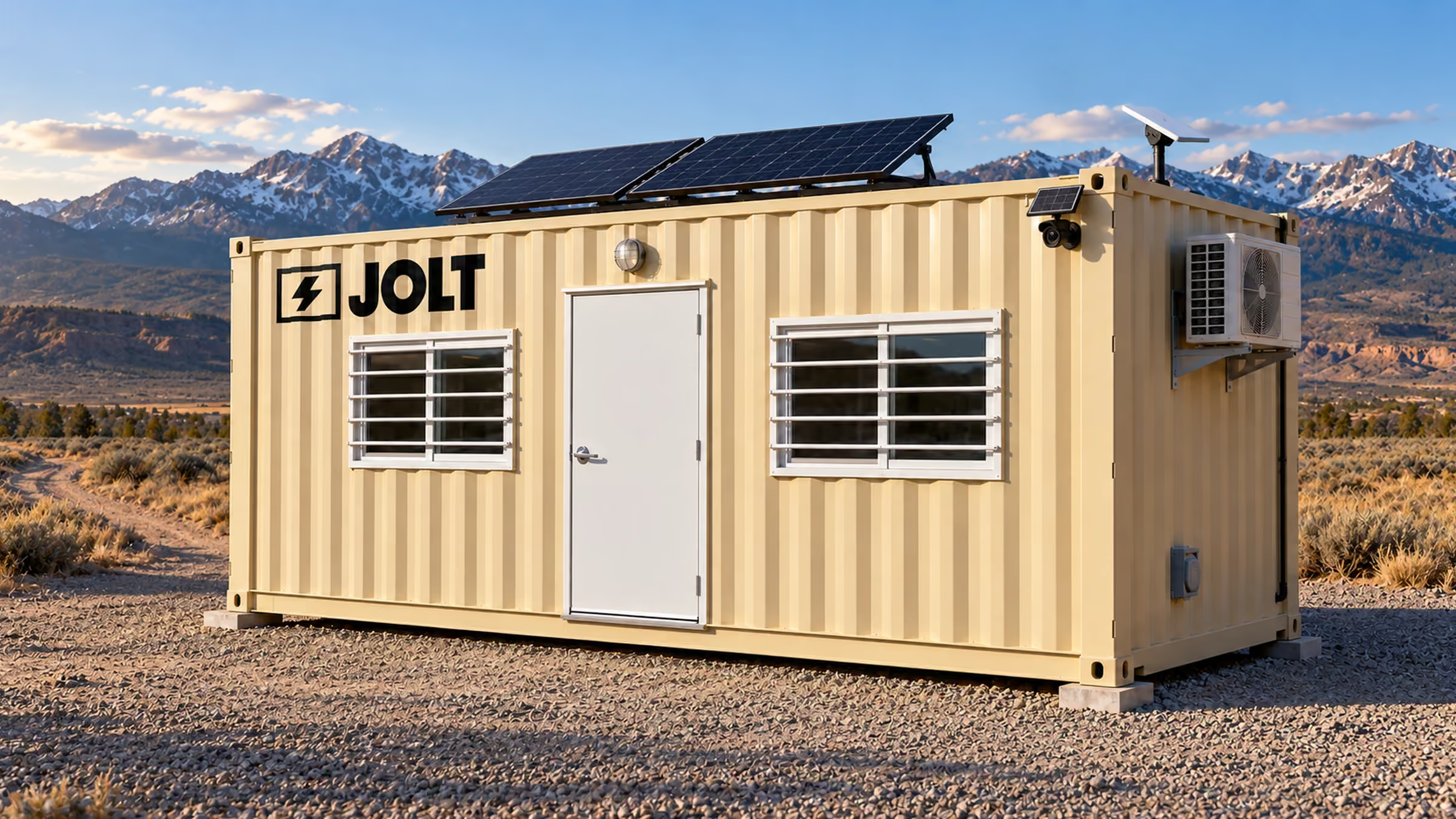
A jobsite office without utility electricity can run from a generator, a solar-battery system, or a combination of both; the right choice starts with a 24-hour load budget. JOLT's Grid-Free 20 ft office rents for $1,495/mo and carries a 10 kWh battery pack that runs its mini-split without shore power.
Which power route fits the schedule?
Temporary utility service is usually the first choice when a project will use substantial electricity for months. It can support the office alongside other approved temporary loads, but it requires coordination among the utility, electrician and inspector. The office is only one part of that sequence.
A generator is independent of the utility schedule. It can serve a short phase or cover a known outage, provided it is sized for running watts and starting demand. The tradeoffs are fuel handling, sound, exhaust placement, maintenance and a person assigned to check it.
Solar plus battery removes daily refueling from normal office operation. Its limit is energy, not optimism: the array has to replace what the office consumed, and the battery has to bridge nights and poor production. December in Colorado averages roughly 3 peak-sun hours a day, while June can reach 6 or more (NREL National Solar Radiation Database).
| Route | Strong fit | Main constraint | Daily field task |
|---|---|---|---|
| Temporary utility service | Long project with several electrical loads | Utility, inspection and electrician sequence | Protect cords, panels and connection |
| Generator | Short phase, high intermittent demand or backup | Fuel, exhaust, sound and maintenance | Inspect, fuel and log runtime |
| Solar plus battery | Predictable office electronics and remote sites | Winter production and battery capacity | Keep panels clear and watch state of charge |
| Solar plus standby generator | Remote office where downtime matters | Two systems to plan and maintain | Use generator only under the written trigger |
For a remote civil package, ranch improvement or early mountain mobilization, start with the off-grid and remote solution. Then decide whether your office needs full HVAC every hour or only communications, lighting and charging.
How do you build a daily load budget?
List each device, its draw in watts and the hours it actually runs. Multiply watts by hours, then divide by 1,000 to get kilowatt-hours. Do not size from the largest nameplate alone; energy over the workday determines battery capacity, while the simultaneous peak determines inverter or generator capacity.
Here is a planning day for two people. The ranges use typical device draws, not measurements from an assigned machine. Confirm actual labels before final electrical design.
| Office load | Planning draw | Daily use | Planning energy |
|---|---|---|---|
| 2 laptops | 60 W each | 8 hours | 0.96 kWh |
| 2 monitors | 30 W each | 8 hours | 0.48 kWh |
| LED lighting | 40 W total | 10 hours | 0.40 kWh |
| Starlink Mini | 35 W | 12 hours | 0.42 kWh |
| 2 phone chargers | 8 W each | 3 hours | 0.05 kWh |
| Small miscellaneous load allowance | 50 W | 4 hours | 0.20 kWh |
| Planning day before HVAC | 2.51 kWh |
The same office will not consume exactly 2.51 kWh every day. A laptop charger cycles, a monitor sleeps, cloud cover can reduce production and crews leave lights on. Use the table to expose assumptions, then carry a reserve rather than treating a calculated decimal as promised runtime.
Heating changes the scale. A 1,500 W resistance heater draws 1.5 kWh in one hour at full output. Four hours would consume 6 kWh before laptops or lights. A one-ton mini-split commonly draws roughly 0.8–1.5 kW while running and can work harder in deep cold, so the actual assigned unit and weather matter.
That is the dividing line between a light-load battery kit and an HVAC-capable office. The winter office heating answer covers heat operation; keep this calculation focused on whether your source can carry it.
What does temporary utility service require?
Temporary service starts with the local utility's process, not with an extension cord from a neighboring building. A licensed electrician sets the temporary equipment, the Colorado State Electrical Board inspection process applies, and the utility energizes after its requirements are met. NEC Article 590 covers temporary installations.
Service territories vary. Holy Cross Energy serves Eagle County and much of the Roaring Fork Valley, while Glenwood Springs operates a municipal utility. Xcel Energy serves Denver, Boulder and Summit County, and Yampa Valley Electric serves Steamboat Springs. Utility lead times vary, so ask early and keep the office-power plan separate from a hoped-for energization date.
The Base 20 ft office has a 50-amp shore-power inlet. Connections must use the provided inlet and be completed by a licensed electrician to code under Rental Agreement §7.2. The customer supplies and pays for electricity under §7.5.
Construction receptacles also need protection. OSHA requires GFCI protection, or an assured equipment grounding program, for applicable 120-volt, 15- and 20-amp receptacles (29 CFR 1926.404(b)(1)). Have the project's electrician determine the compliant distribution arrangement instead of assembling adapters in the field.
Utility service wins when it will arrive early enough and support many site loads. It loses when grading, inspection or utility work falls behind the date the superintendent needs drawings, email and heat. Carry a bridge plan through actual energization, not merely the requested date.
When does a generator make sense?
A generator works when the load exceeds a small battery system, the phase is brief, or it serves as backup. Size it from the office's simultaneous running load plus startup behavior, then have the electrician check the connection, grounding and protection required for the selected equipment.
Do not select a generator from the mini-split estimate alone. Add computers, lights and every appliance that can be on at the same time. A microwave or resistance heater can create a much larger short-term load than the normal electronics, and crews will eventually switch two things on together.
A mid-size portable inverter generator burns roughly one-third of a gallon per hour at quarter load and close to a gallon per hour near full load, based on manufacturer specification sheets. Check the sheet for the exact model. Fuel cost is not the only concern; somebody must transport fuel, store it under the site rules, refill safely and record maintenance.
CPSC guidance places portable generators outdoors at least 20 ft from doors, windows and vents, with exhaust directed away. Never put one inside the office, a storage container or another enclosed area. Carbon monoxide does not become safe because a door is cracked.
Sound also affects placement. A machine beside the personnel door can make calls difficult and invites crews to move it somewhere unsafe. Resolve exhaust, cable protection, theft exposure and refueling access on the logistics plan before delivery.
The customer supplies and pays for fuel under Rental Agreement §7.5. If site lighting is the larger need, a trailer-mounted light tower combines a generator cabinet with four LED floodlights on a mast reaching about 30 ft. It is lighting equipment, not an office power supply; whether its generator can feed anything else is a question for the assigned unit's manual and your electrician.
What can the POWER kit actually run?
The POWER upgrade has two 400 W panels, a 3 kWh LFP battery and an inverter. It is designed for Starlink, the camera, LED lights, laptops and phones for about two days without sun. It rents for $399/mo and can stack on an eligible office or storage container.
"About two days" describes the intended light-load mix, not two days at any load plugged into an outlet. A 3 kWh battery is in the same range as the sample two-person day before losses and reserve, which is why active use has to stay disciplined. The supplied system specification, controls and connected-load limits govern the assigned kit.
POWER does not run the mini-split or the READY heater. One hour of a 1,500 W heater represents half of the battery's nominal 3 kWh capacity before conversion losses and reserve. Running heat would consume the energy intended to carry communication, workstations and lights through darkness.
Snow is another operational limit. Snow covering a panel stops production until it is cleared. The customer must keep panels, roofs, doors and access paths clear under Rental Agreement §7.4, so assign that inspection with the morning site walk.
The kit makes sense for a Base office used as a plan room during mild weather, or for a connected tool crib where laptops, phones and communications are the critical loads. It is not a substitute for HVAC-capable power during a January mobilization.
If the office also needs WATCH and CONNECT, JOLT PACK groups WATCH, CONNECT and POWER for $699/mo. Do not add it to Grid-Free or Alpine, because both already include those three functions.
Why is Grid-Free different from a small battery kit?
The Grid-Free office includes everything in Base, plus WATCH, CONNECT and POWER functions built in and a 10 kWh battery pack that runs the HVAC. It requires no shore power. That explicit HVAC capability is the important difference, not just a larger capacity number.
A 10 kWh pack still has a finite energy budget. Outdoor temperature, thermostat setting, door openings, solar conditions and the rest of the office load affect runtime. The crew should watch battery condition, keep panels clear and avoid adding unplanned resistance loads.
| Item | Price |
|---|---|
| $795 /mo | |
Most popular | $1,495 /mo |
| $1,895 /mo |


3-month minimum on every office; $750 reservation deposit.
The Base tier rents for $795/mo, Grid-Free for $1,495/mo and Alpine for $1,895/mo. All have a 3-month minimum. Alpine includes Grid-Free's solar array and 10 kWh battery, then adds its mountain envelope and backup heat, so no shore power is required.
For a Grand Junction jobsite, cooling load may control the summer plan. At a Steamboat Springs site, low winter temperature and snow production can control it. Use the same load method in both places, but change the weather assumptions and operating rules.
The Grid-Free or Alpine tier is the direct answer when office HVAC must work before utility service. POWER is the leaner choice when HVAC can remain off and the essential loads are electronic.
Is a solar-generator hybrid worth it?
A hybrid uses solar and battery for normal operation, with a generator held for a defined exception. This avoids running an engine all day for a modest average load, while preserving a response to prolonged poor solar production or unusual work.
The key is a written trigger. Examples include a battery state set by the equipment instructions, a forecasted storm period, or a planned high-load meeting day. "Start it when someone thinks the battery looks low" creates inconsistent operation and makes fuel planning impossible.
Keep generator safety unchanged just because it is backup. It still belongs outdoors, away from openings, with approved electrical connection and a named operator. Test it before the first storm rather than discovering a stale-fuel or cable problem during an outage.
A hybrid does not justify connecting every tool on site to the office. Separate the critical office circuit from saws, compressors, welders and temporary heat unless the electrical design specifically includes them. Preserving office communication is easier when production loads have their own plan.
The off-grid solar-battery guide goes deeper on sizing and seasonal production. Use it to challenge the load assumptions, then have the responsible electrician approve any field connection.
How should the office and power equipment be placed?
Solar needs sky exposure through the useful part of the day. Avoid locating the container where a building, spoil pile or tree line will shade the roof as construction advances. A clear roof in September can be behind a framed wall in November.
Generator placement needs safe exhaust separation and a protected cable route. The office door, windows and HVAC openings all matter. Keep the refueling path out of public circulation and away from hot work.
Delivery needs its own geometry. The customer provides a firm, level, well-drained surface and about 70 ft of straight-line clearance for a 20 ft unit, plus overhead clearance and marked utilities under Rental Agreement §5.2. A representative must be present, and customers may not relocate the unit themselves.
Think ahead to snow storage and panel clearing. Do not place the solar side under the plow's discharge or beside a roof that sheds onto it. Keep enough working room to clear snow without stepping onto the container roof.
Reservation also sets the transport schedule. Standard delivery is a 2–4 week window from reservation. A Base office can use JOLT Express for $750, which places it on site within 7 business days subject to Rental Agreement §5.1, but Grid-Free uses the standard window.
What should you reserve?
Reserve POWER with a Base office when the workday is mainly laptops, LED lights, phones and communications, and HVAC can stay off. Reserve Grid-Free or Alpine when heat or cooling must operate without shore power; choose a properly planned generator solution when loads exceed the solar-battery scope or the office only needs a short bridge.
Before you reserve, bring the job address, required delivery window, a 24-hour device list, heating and cooling expectations, panel sky view and the name of the person responsible for daily energy checks. Tell us whether utility service is pending and whether a generator will be primary or standby so the reservation reflects the real operating plan.
Questions contractors ask
What is the simplest way to power an office before utility service?
Use a solar-battery system when the load is lights, laptops and communications, or a system sized for HVAC when heating and cooling are required. JOLT's Grid-Free office is $1,495/mo and needs no shore power.
Can the POWER upgrade run an office mini-split?
No. POWER is $399/mo and supports Starlink, a camera, LED lights, laptops and phones, but it does not run the mini-split or READY heater.
How long does the POWER battery last without sun?
For its intended light office loads, POWER is designed for about 2 days without sun. Actual runtime changes with laptop use, lighting hours, charging demand and the battery's starting charge.
Does the Grid-Free office run heating and cooling?
Yes. The Grid-Free office has a 10 kWh battery pack that runs its mini-split and rents for $1,495/mo with a 3-month minimum.
Who supplies generator fuel and jobsite electricity?
The customer supplies and pays for electricity and fuel under Rental Agreement section 7.5. Plan refueling, safe storage and shutdown responsibility before the office opens.
Where should a portable generator be placed?
CPSC guidance says to operate it outdoors at least 20 ft from doors, windows and vents, with exhaust pointed away. Follow the manufacturer instructions and the site's electrical plan as well.
How much power does a 1,500 W heater use?
At full output, a 1,500 W heater uses 1.5 kWh for each hour it runs. That load is why the $399/mo POWER kit does not support the READY heater.
Can solar and a generator be used together?
Yes. A Grid-Free or Alpine office can handle normal operation while a correctly selected generator remains a contingency for prolonged poor solar conditions or an unusual load.
Keep reading
- RentGrid-Free: drop it anywhere. It runs itself.
- UpgradePOWER: two days of power with no sun and no hookup
- UpgradeThe JOLT Pack: eyes, internet, power. Save $88.
- GuideRun the field office before utility power reaches the site.
- SolutionRentals for off-grid & remote
- AnswerHeating a container office at 8,000 feet in January
- RentLight towers for the dark half of the year
- JOLTPrices. All of them.
Ready when your site is.
Rentals from $85/mo · every price published
A deposit holds your delivery window. Cancel free of charge more than 14 days before the first day of the window. Deposits from $85 are applied to your first invoice.