

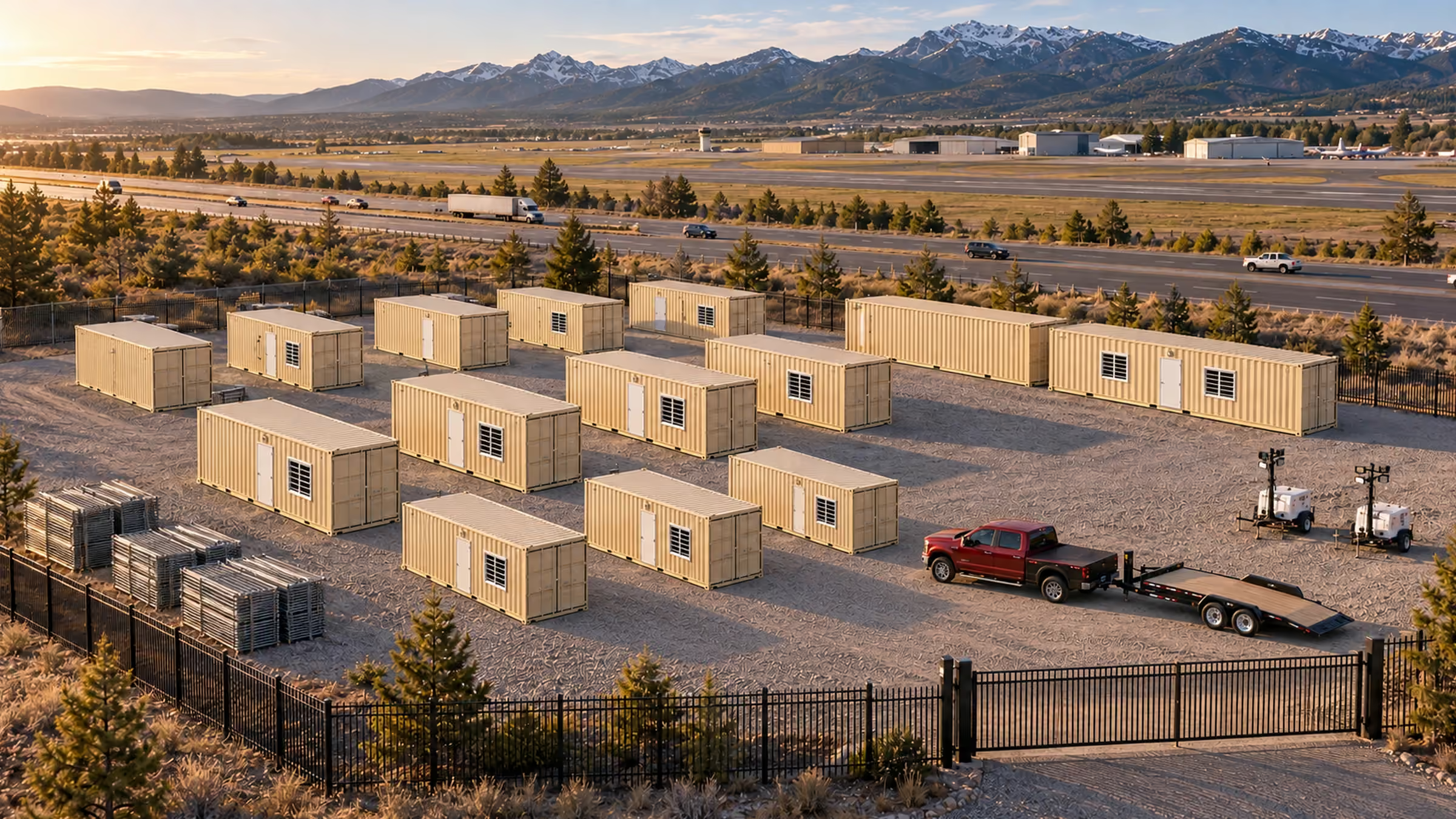
Denver County, Colorado · Zone E
Jobsite container and office rental in Denver
Zone E delivery at $1,200 each way, 132 road miles over the Divide, with the honest math on when a mountain yard beats a Denver one and when it does not.
$1,200each way
Delivery $1,200 to Denver, pickup $1,200; standard window 2–4 weeks.
- Zone
- E
- From our yard
- 132 mi
- Pickup
- $1,200
- Minimum term
- 1–3 mo
What we deliver to Denver
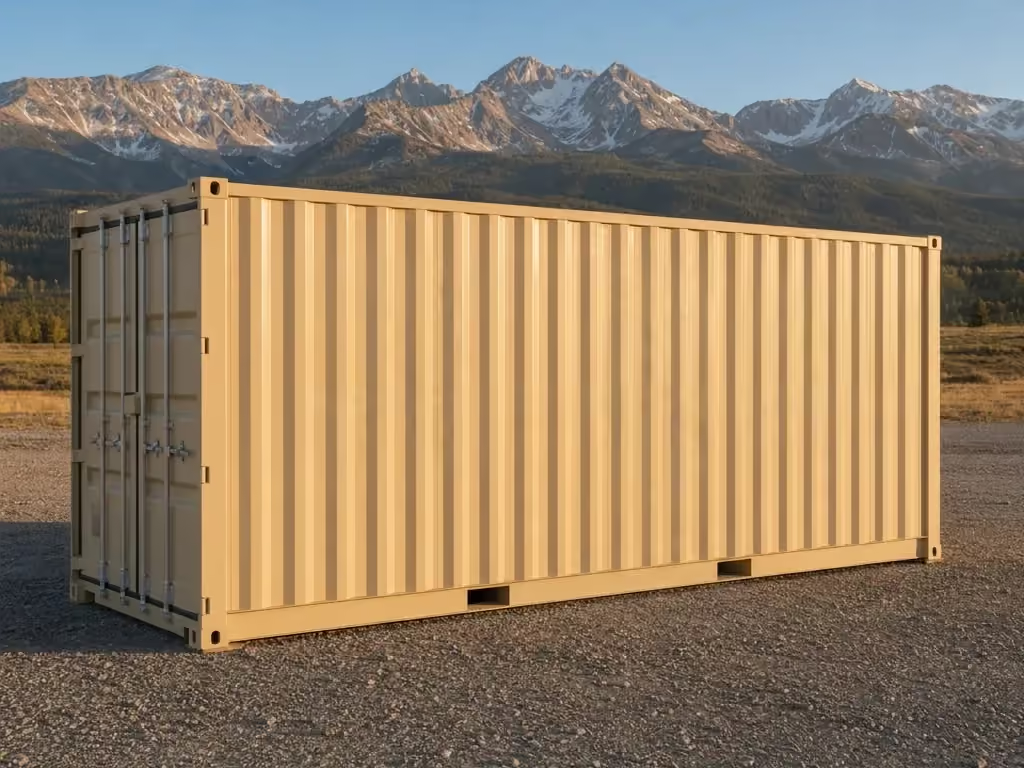

Key facts
- Delivery to Denver (Zone E) costs $1,200 each way as of .
- The Grid-Free 20 ft office container rents for $1,495 per month in Denver as of .
- The 40 ft storage container rents for $425 per month in Denver as of .
- Standard delivery is scheduled 2–4 weeks after the reservation as of .
- Denver is 132 road miles from the JOLT yard at Gypsum as of .
Cite this page: "Jobsite container and office rental in Denver." JOLT (Jolt Rents), https://joltrents.com/locations/denver. Last updated September 11, 2026.
Denver is a Zone E delivery from our Gypsum yard: $1,200 each way, 132 road miles over Vail Pass and through the Eisenhower–Johnson Memorial Tunnel, inside the standard 2–4 week window. That fee is the true cost of bringing a mountain-grade unit over the Divide, and this page is about when it pays and when a Denver yard is the better call, with the numbers in the open.
What does delivery to Denver cost?
Delivery is $1,200 and pickup is $1,200, billed as two legs with nothing added for fuel, the tunnel or the season. Every ZIP that begins 802 prices in Zone E, whether the address sits inside the City and County of Denver or in a north-side neighbor that shares the prefix; the suburbs have their own pages, Lakewood, Aurora, Arvada, Littleton, Centennial, Golden and Boulder among them, at the same fee.
| Zone | Towns | Delivery | Pickup |
|---|---|---|---|
| Zone A | Gypsum, Eagle, Edwards, Avon, Beaver Creek | $400 | $400 |
| Zone B | Vail, Minturn, Glenwood Springs | $550 | $550 |
| Zone C | Breckenridge, Frisco, Silverthorne, Keystone, Carbondale, Basalt, Aspen, Snowmass | $750 | $750 |
| Zone D | Steamboat Springs, Leadville, Grand Junction | $950 | $950 |
| Zone E | Idaho Springs, Georgetown, Evergreen, Golden, Morrison, Lakewood, Arvada, Aurora, Centennial, Littleton, Boulder, Castle Rock, Denver | $1,200 | $1,200 |
| Zone F — Mountain West12-month minimum | WY, ID, UT, MT | $1,795 | Pickup quoted separately before delivery |
The fee is the same for a 10 ft storage container and a 40 ft office, because the line pays for a truck day across the state and back, not for the weight on the bed. The delivery zones page explains how the zones are drawn and the Colorado hub lists every town with its mileage.
When does a Gypsum yard make sense for a Denver job?
When the rental is long and the unit is an office. Two Zone E legs, delivery and pickup, come to about three months of Base 20 ft office rent at $795/mo, and on a project that runs twelve or eighteen months that is a line item, not a deal-breaker. Against the Alpine 20 ft office at $1,895/mo or the 40 ft office with bathroom at $1,595/mo, the same two legs are less than two months of rent.
What the mileage buys is the unit and the terms. Every 20 ft office is a steel ISO shell with mini-split heat and cooling, a 36-inch steel door and two barred slider windows, and the upgrades are installed at the yard before the truck leaves: WATCH at $129/mo, CONNECT at $259/mo, POWER at $399/mo, or those three together in the JOLT PACK at $699/mo, plus READY at $125/mo if the office should arrive furnished and heated. The price is on the page, the deposit is published, the cancellation terms are in section 2.2 of the rental agreement, and there is no quote step between you and the number.
The third case is the contractor who already works with us in the mountains. A firm with a job in Vail or Breckenridge and another in Denver gets one vendor, one agreement, one invoice format and one phone number for both, and one point of contact when the second job starts; the Denver jobsite office cost answer walks through a full-year example with every line shown.
When should you rent from a Denver yard instead?
When the rental is short and the unit is a box. Two Zone E legs equal about eight months of 20 ft storage container rent at $295/mo, and nearly eleven months of 10 ft storage container rent at $225/mo, so a one- or two-month storage-only job in the metro should go to a local yard whose truck is already on your side of the tunnel. We would rather say that here than have you find it in the reserve flow.
The same holds for a tight schedule that needs a unit faster than the standard window on something other than a Base office, because JOLT Express covers that one unit only, and for a bare box with no upgrades where the unit itself is a commodity. The monthly container rental cost answer and the rent versus buy answer help settle the short-term case before you spend time on either yard.
| What to compare | JOLT from Gypsum | Ask the Denver yard |
|---|---|---|
| Delivery and pickup fee | Published flat Zone E fee each way, on this page | Whether the fee is flat, per mile or per hour, and whether pickup is quoted separately |
| Route | 132 road miles over Vail Pass and through the tunnel, with weather days in winter windows | Local, and whether same-week delivery is available at the quoted price |
| Unit condition | One-trip ISO steel, mini-split heat and cooling in every office | One-trip or used, and whether the office is a container or a trailer |
| Camera, Starlink, solar, furnishings | Installed at the yard before delivery, published monthly prices | Whether each is offered, by whom, and at what monthly rate |
| Terms | Rental agreement published in full, free cancellation more than 14 days out | Whether the agreement is available before signing, and the cancellation window |
| Best fit | Offices on long projects, mountain-grade units, one vendor for mountain and metro work | Short storage-only rentals, single boxes, same-week needs |
How does the truck get to Denver?
The route is I-70 the entire way: east over Vail Pass at 10,662 ft (Wikipedia), through Summit County, then through the Eisenhower–Johnson Memorial Tunnel, which sits at an average elevation of 11,112 ft about 60 miles west of Denver and sees roughly 315 inches of snow between November and April (CDOT), and down past Georgetown and Idaho Springs to the metro. All 132 miles sit inside the stretch between Dotsero and Morrison where CDOT requires commercial vehicles to carry chains from September 1 through May 31 (CDOT).
That is why winter windows to the Front Range include weather days, and why a closure at the tunnel or the pass costs a delivery day rather than an hour. Georgetown and Idaho Springs sit on the same road in Zone E, and the mountain delivery guide explains how a long-route delivery is planned and what a site can do to make the first attempt the only one.
Which office works for a Denver site?
Denver sits at 5,280 ft (Wikipedia), and a metro project sees hot summers and a winter with hard cold snaps rather than the constant load of the high country. The Base 20 ft office at $795/mo covers most powered lots with a mini-split that runs both ways, a 50-amp shore-power inlet and a 3-month minimum, and READY delivers it furnished and heated.
A full crew on an infill, institutional or civil project takes the 40 ft office container with bathroom at $1,595/mo, which puts the superintendent, the plan table and an enclosed toilet under one roof; the 20 ft versus 40 ft guide compares them. A lot where the temporary service is weeks out takes the Grid-Free 20 ft office at $1,495/mo, which arrives with solar, a 10 kWh battery, Starlink and a camera built in, and a foothills site or a project that will run through the winter takes the Alpine, whose standing-seam over-roof and backup heat were built for the towns up the road. The container office versus trailer comparison is the read before renewing a trailer lease.
Which storage container fits a Denver lot?
Metro lots run from an alley behind a scrape-and-build to an acre of industrial pavement, and the fleet covers both ends: the 10 ft at $225/mo and 12 ft at $325/mo for a parking bay or an alley, the 20 ft at $295/mo for a single building, and the 40 ft storage container at $425/mo on a 3-month minimum for an industrial or institutional job with a 100 ft straight approach. The 20 ft and 40 ft are one-trip ISO containers with the padlock inside a welded lockbox, and the 10 ft and 12 ft open through a man door with a barred window on the long side.
On a metro site theft is the first question, and the theft answer and the security camera answer cover what a lot visible from a busy street all night should add beyond the lock. Temporary fence at $3.50/LF/mo with installation at $1.75 per linear foot closes the perimeter, and the OSHA fence answer covers what a site next to a sidewalk is expected to keep behind it.
Do you need a permit for a container in Denver?
On private property, Denver's Community Planning and Development treats a construction storage yard and a construction fence as temporary uses under the Denver Zoning Code, "Building or Yard for Construction Materials" in section 11.11.5 and "Fence for Demolition or Construction Work" in section 11.11.7 (Denver Zoning Code), and the temporary-use permit runs with the project. The Denver container answer walks through the application, and section 5.2 of the rental agreement makes the permit and any landlord consent yours to hold before the truck arrives.
In the street it is a different permit and a different office. Denver's Department of Transportation and Infrastructure requires a Right-of-Way Revocable Street Occupancy Permit before any container is placed in the right-of-way, the permit must be obtained by the container company rather than the contractor, the company must hold a right-of-way dumpster license, and the department asks for five business days (Denver DOTI). If your site plan puts the unit at the curb rather than on the lot, tell us at reservation so the permit question is settled before the truck is scheduled.
How does a Denver winter treat the unit?
The Structural Engineers Association of Colorado lists Denver at a 35 psf recommended ground snow load in its 2016 Colorado Design Snow Loads report (SEAC), less than half the 80 psf it lists for Breckenridge, with the local building official setting the code value. It is a ground load for designing buildings rather than a rating for a container roof, which is not published for any rental unit, and at 35 psf the Alpine over-roof is a foothills option here rather than a requirement; our snow load guide has the arithmetic.
Section 7.4 of the agreement still makes snow and ice removal from the roof, the panels, the doors and the access paths your crew's job after a spring storm, and section 12.2 excludes damage from failure to clear snow or ice from the damage waiver. A light tower at $1,250/mo carries the short afternoons, and a ground heater at $1,450/mo in season keeps a winter pour on schedule; the winter office answer covers what it is like inside.
What does the truck need at a Denver site?
The same thing it needs in Vail: section 5.2 of the agreement calls for a firm, level and drained pad, 70 ft of straight approach for a 20 ft unit or 100 ft for a 40 ft, utilities located and marked, and a representative of yours on site to direct the set. In Denver the approach is more often a street or an alley than a driveway, and the delivery space answer and the truck size answer are the pages to hold up against the lot before you reserve.
Metro sites trade slope for overhead lines, alley widths and parked cars: an alley approach that is long enough on paper is blocked by a neighbor's truck on delivery morning more often than by grade. Cone the approach the night before, keep the foundation answer in mind for a pad on old fill, and remember that section 5.3 charges a failed delivery as a trip and charges the return as another, which at Zone E is the most expensive line on this page.
How do you power and connect a Denver office?
Every office is wired to a single 50-amp shore-power inlet, and under section 7.2 of the agreement a licensed electrician makes the connection, to code, through that inlet only. Metro temporary service usually arrives faster than it does in the mountains, but where it has not, the Grid-Free office's 10 kWh battery carries the site, and the off-grid power answer states plainly what it runs and for how long.
Cell coverage is not the problem in Denver that it is in the mountains, but a steel box in a downtown canyon still drops calls, and CONNECT at $259/mo puts a Starlink dish and router on any unit; the Starlink cost answer compares the upgrade against buying a kit for one job.
What does a Denver rental cost, and how do you reserve?
Monthly, you pay the product-page rent, a line for each upgrade you carry, the 12% damage waiver and the 5% environmental fee figured on rent plus those recurring upgrades, and sales tax at the rate for the job address; the $1,200 delivery and the $1,200 pickup are one-time lines at either end of the rental. The office deposit is $750 and the storage deposit $350, both applied to the first invoice; offices and the 40 ft box carry a 3-month minimum and the smaller boxes 1 month; section 3.4 adds 5% at each anniversary. The pricing page shows every fee and deposit on one screen, which is the page to put beside a Denver yard's quote.
Enter an 802 ZIP in the reserve flow and it shows Zone E, the fee each way and the deposit before anything is charged; availability is whatever the live badge on the product page says today, and JOLT Express can have a Base office on a metro site within 7 business days for $750. Section 2.2 lets you cancel in writing for a full refund more than 14 days before the window opens; section 16 asks for 15 days' written notice before pickup and runs rent until the unit is retrieved; how it works covers the steps from reservation to the truck's return over the Divide.
Last updated .
Questions contractors ask
What does delivery to Denver cost?
Denver is Zone E: $1,200 for delivery and $1,200 for pickup, 132 road miles from our Gypsum yard over Vail Pass and through the Eisenhower–Johnson Memorial Tunnel. Every 802 ZIP prices the same, and the suburbs have their own pages at the same Zone E fee.
Is it worth bringing a unit from Gypsum instead of renting in Denver?
For a long-term office, often yes; for a one-month storage box, usually no. Two Zone E legs come to about three months of Base 20 ft office rent at $795/mo, spread over a year or more of a project, but the same two legs equal about eight months of 20 ft storage rent at $295/mo, which no month-to-month job can carry.
What do I get for the mileage?
A published price with no quote step, a steel unit built for mountain winters, and the WATCH, CONNECT, POWER and READY upgrades installed at the yard before the truck leaves. A contractor with work in both the mountains and the metro also gets one vendor, one agreement and one invoice format for both.
Do I need a permit to put a container on a Denver street?
Yes. Denver's Department of Transportation and Infrastructure requires a Right-of-Way Revocable Street Occupancy Permit before a container goes in the right-of-way, the container company must obtain it, the company must hold a right-of-way dumpster license and the department asks for five business days. Tell us at reservation if your plan puts the unit in the street rather than on the lot.
What about a container on private property in Denver?
Community Planning and Development treats a construction storage yard and a construction fence as temporary uses under the Denver Zoning Code, sections 11.11.5 and 11.11.7, and the temporary-use permit runs with the project. Section 5.2 of our rental agreement makes that permit and any landlord consent yours to hold before delivery.
How long does a Denver delivery take?
The standard window is 2–4 weeks from reservation, and JOLT Express puts a Base 20 ft office on site within 7 business days for a one-time $750, on that unit only. Between September 1 and May 31 the route is under CDOT's commercial chain law from Dotsero to Morrison, so winter windows include weather days.
Which office makes sense for a Denver site?
The Base 20 ft office at $795/mo for a powered lot, the 40 ft office with bathroom at $1,595/mo for a full crew, and the Grid-Free at $1,495/mo for a lot with no service or no time to wait for it. The Alpine at $1,895/mo belongs on a foothills site or any project that will run through a Front Range winter.
What snow load does a container in Denver see?
The SEAC 2016 Colorado Design Snow Loads report lists Denver at a 35 psf recommended ground snow load, less than half of Breckenridge's 80 psf, with the local building official setting the code value. Section 7.4 of the agreement still makes clearing the roof, doors and paths your crew's job after a spring storm.
Keep reading
- AnswerShipping containers on private property in Denver
- AnswerJobsite office cost in Denver — Denver yards vs. our I-70 yard
- GuideA container office or an office trailer — which one fits your jobsite?
- LocationJobsite rentals in Idaho Springs — from our I-70 yard
- LocationJobsite rentals in Georgetown — from our I-70 yard
- LocationJobsite rentals in Evergreen — from our I-70 yard
- LocationJobsite rentals in Golden — from our I-70 yard
- LocationJobsite rentals across the Colorado mountains
Delivered to Denver.
$1,200 delivery · Zone E
A deposit holds your delivery window. Cancel free of charge more than 14 days before the first day of the window. Deposits from $85 are applied to your first invoice.