
Straight answer
What the rules actually require for jobsite fencing in Colorado
Colorado jobsite fence rules explained across OSHA, building and fire codes, local permit conditions and 6 ft panel limitations.
- Reading time
- 9 min
- Updated
- 2026-09-10
- Rentals from
- $85/mo
- Talk to us
- 970-279-1015

Key facts
- Temporary fence rents for $3.50 per linear foot per month as of .
- Fence install costs $1.75 per linear foot as of .
- The 10 ft storage container rents for $225 per month as of .
Cite this page: "What the rules actually require for jobsite fencing in Colorado." JOLT (Jolt Rents), https://joltrents.com/answers/jobsite-fence-requirements-colorado-osha. Last updated September 10, 2026.
OSHA does not require perimeter fence around every Colorado construction site, but specific hazards and locally adopted codes can require barriers that are 6 ft or 8 ft high. JOLT rents 6 ft by 10 ft temporary fence panels for $3.50/LF/mo, so compare that equipment with the exact permit condition before ordering.
Which authorities can require a jobsite barrier?
Four separate systems can affect one fence line. Federal OSHA regulates worker safety and particular hazards. The city or county adopts building and fire codes. A local planning, public-works or building department adds permit conditions. The owner, HOA, resort or project safety plan may impose a stricter contract requirement.
Do not collapse those systems into a statement that "OSHA requires 6 ft fence." That sentence is usually wrong and can lead to the wrong height, location or type of protection. Begin with the work hazard and the adopted local code, then read every approved logistics drawing and permit note.
| Rule source | Verified reference | Practical question for the line |
|---|---|---|
| Federal worker safety | 29 CFR 1926 | Is there a controlled zone, excavation, access or sign requirement? |
| Pedestrian protection | IBC Chapter 33, Section 3306 | How close are the work and public way, and how high is the work? |
| Fire prevention | NFPA 241 through IFC Chapter 33 | How will unauthorized entry be restricted while fire access remains open? |
| Local permit | City or county adopted codes and amendments | What height, screening, staging and right-of-way notes were approved? |
| Civil exposure | C.R.S. 13-21-115 | Are children or other entrants exposed to an artificial condition? |
| Contract controls | Owner, HOA, venue or resort requirements | Does the project promise more than the minimum code? |
Colorado has no statewide commercial building code. Cities and counties adopt editions of the International Codes and amend them locally. Denver, Eagle County, Summit County, Pitkin County and many Front Range jurisdictions use recent editions, but the permit set and local amendments control the actual project.
JOLT does not decide what law requires for a particular site. The superintendent should confirm the line with the authority having jurisdiction, fire official, project safety team and owner before reservation. We can then price and install the equipment described in the accepted layout.
What does OSHA require around construction work?
OSHA has no universal rule directing every employer to surround every construction project with perimeter fence. Its construction standards address the hazards workers face and the controls for those hazards. A perimeter can support compliance, but the word "fence" does not substitute for the specific control.
Controlled access zones are addressed in 29 CFR 1926.502(g). Excavations fall under Subpart P, including 29 CFR 1926.651. Housekeeping appears at 1926.25, and accident-prevention signs and tags at 1926.200. Each provision answers a different safety question.
A controlled access line is not automatically the same thing as the outer property fence. Its location follows the protected work and can change as that work moves. Likewise, an excavation needs protection based on its conditions and exposure; putting chain link at the property boundary does not correct unsafe access at the edge.
Housekeeping affects the perimeter because debris can defeat a barrier. Scrap stacked against a panel becomes a climbing aid, and material blocking an opening can interfere with emergency movement. Signs communicate a warning, but a warning sign does not physically separate a pedestrian from a hazard.
For an OSHA inspection, be ready to explain why the chosen control matches the cited hazard. Show the competent-person process, current plan and daily correction record. "We rented fence" is not the same answer as identifying how access to the excavation, fall zone or active operation is controlled.
When does the building code call for 6 ft or 8 ft?
IBC Chapter 33 covers safeguards during construction. Section 3306 addresses protection of pedestrians near construction and demolition. Table 3306.1 selects protection based on the height of construction and the distance between the work and the public way (IBC Section 3306).
Where that table calls for a barrier, Section 3306.5 requires it to be at least 8 ft high. A standard JOLT panel is 6 ft high, so it does not satisfy an 8 ft barrier condition merely because it closes the perimeter. The approved protection can also involve railings or a covered walkway, depending on Table 3306.1.
Section 3306.9 has a separate excavation rule. An excavation within 5 ft of a street lot line must be enclosed with a barrier at least 6 ft high (IBC Section 3306.9). A 6 ft panel matches that stated height, but height alone does not establish full compliance. Location, stability, continuity, openings and local amendments still matter.
Measure from the feature named in the rule, not from a convenient curb or fence already in the field. Confirm what the building official treats as the public way or street lot line. Civil drawings, survey control and the approved logistics plan should agree before installation.
How do fire code and premises liability change the plan?
NFPA 241, Standard for Safeguarding Construction, Alteration and Demolition Operations, requires the site to be secured against unauthorized entry. It is adopted through International Fire Code Chapter 33. The fire official may review access, combustible loading, impairment plans and the way emergency responders reach the work.
Security cannot block fire department access. Coordinate opening locations, key or lock procedures and changing construction routes with the approved fire plan. A line installed from an old logistics drawing can become a problem after excavation, crane setup or vertical construction changes response paths.
Colorado premises liability adds another reason to evaluate access rather than rely on a general warning. C.R.S. 13-21-115 preserves the attractive-nuisance doctrine for children under 14. Open excavations and stacked material are classic conditions that demand attention because a child may not appreciate the risk.
That does not create one statewide fence specification for every lot. It means the project team should identify artificial conditions likely to draw children and choose controls suited to the exposure. In a residential neighborhood, a gap behind a material delivery can matter more than a long, intact run along an inaccessible edge.
The jobsite theft prevention plan addresses after-hours loss controls. Security and life safety overlap, but they are not identical. A camera may notify someone after entry; a required barrier must perform its protective role before entry.
What can local Colorado conditions add?
Local approval can be more specific than a general code summary. Aspen requires a Construction Management Plan. That process can govern staging, public circulation, deliveries and the location of temporary site features. Build the fence line from the approved plan rather than an estimator's early sketch.
Vail requires a construction staging plan approved by the town. Tight lots, pedestrian routes and snow operations can drive openings and setbacks. If an approved drawing shows a particular line, move it only through the process required by the town and project team.
Denver requires a right-of-way permit for anything placed in the public way. Fence feet that fit on private property do not authorize panels, stands or pedestrian detours on a sidewalk. Resolve the permitted traffic and pedestrian arrangement before a delivery truck arrives.
Work along a state highway requires a CDOT permit. Traffic control must follow the Manual on Uniform Traffic Control Devices, which Colorado adopts with a state supplement. A traffic-control package can supply cones, barricades, vertical panels or an arrow board by tier, but the approved traffic-control plan determines how those devices are used.
HOAs, ski resorts and private owners can impose appearance, hours, screening or access terms through contracts and site rules. Those are not OSHA requirements. They still matter to the project and can be stricter than the public minimum, so include them in the bid and logistics review.
The Eagle County office permit material and Colorado container permit answer cover adjacent placement questions. Keep office approval and perimeter approval as separate checklist items even if the same logistics plan shows both.
What does a 6 ft temporary panel system provide?
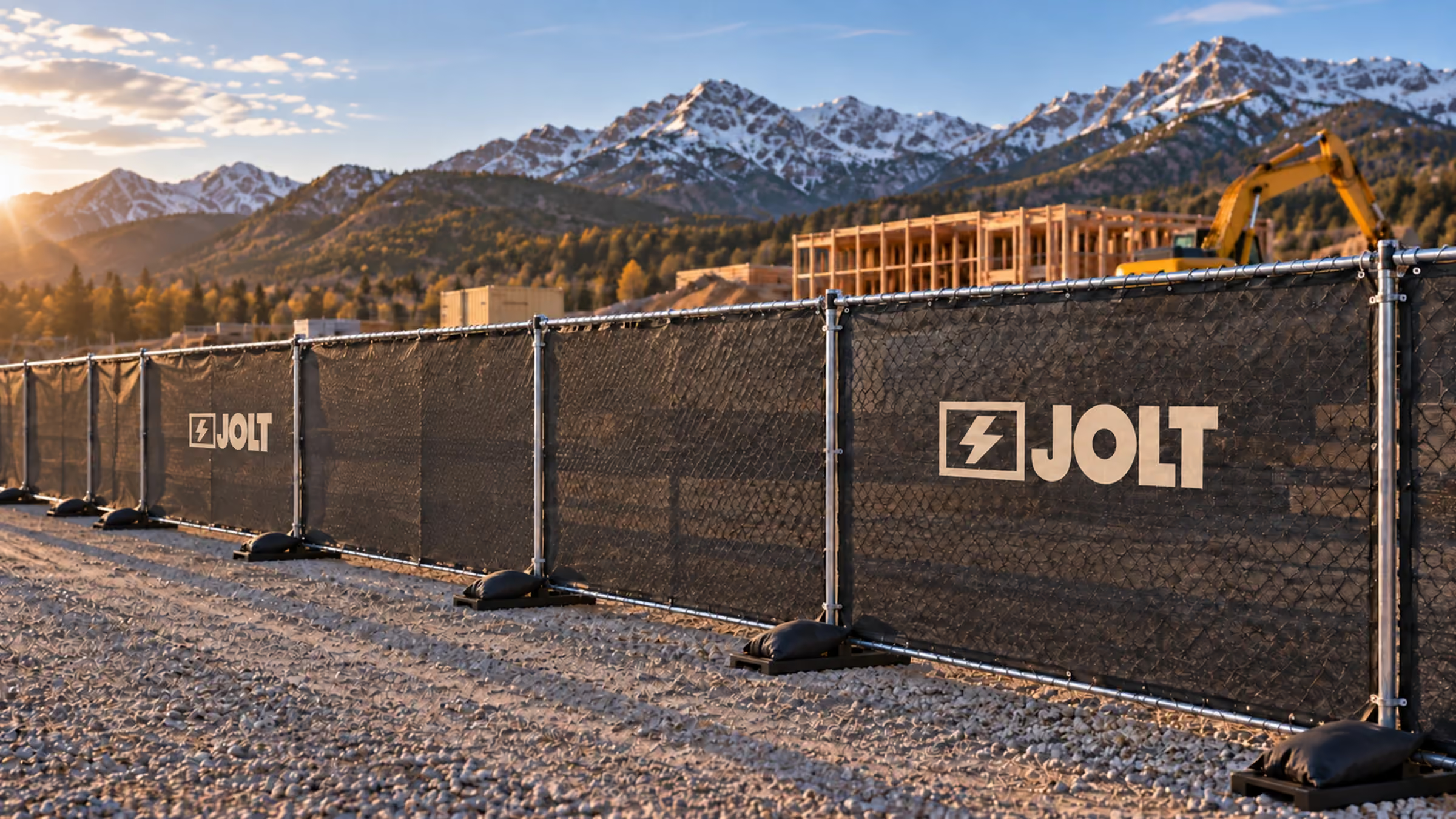
JOLT supplies galvanized chain-link panels that are 6 ft tall and 10 ft wide. Steel tube stands support the panels, and clamps join adjacent sections. JOLT installs the agreed line and removes it at pickup.
| Panel characteristic | What it means in review |
|---|---|
| 6 ft height | Can match a stated 6 ft condition; cannot meet an 8 ft condition |
| 10 ft width | Layout changes occur in panel increments and at corners |
| Freestanding steel stands | No permanent posts; route and surface still need review |
| Chain-link face | Visibility through the line; no privacy screening included |
| Clamped sections | Connections and stands belong in routine inspection |
| Planned openings | Gates are not included in the stated rental equipment |
The system defines a boundary and deters casual entry. It does not provide a covered walkway, overhead protection, guardrail, excavation shoring or traffic-control plan. It also cannot repair a public route that is too narrow or inaccessible.
Gates are not included in the price. Mark vehicle, worker and emergency openings when you submit the layout, and discuss how each will be controlled. An unplanned gap left for a loader is not equivalent to a managed entrance.
Windscreen and privacy screen are also excluded. Adding fabric changes wind loading because a porous chain-link panel begins acting more like a sail. Do not attach screen, banners or signs to rented panels without JOLT's written consent under Rental Agreement §7.
For quantity planning, use the temporary fence panel calculator. Corners, returns, offsets and openings affect the field layout, so do not turn the 10 ft panel width into a final order without reviewing each segment.
What will an inspector or plan reviewer look for?
Expect the reviewer to start with the approved documents. The current permit set, construction-management plan, pedestrian-protection plan, fire plan and traffic-control plan should tell one consistent story. If the field line differs, document the accepted revision.
Continuity is visible immediately. Inspectors notice an open end behind a dumpster, a panel moved for delivery, a stand projecting into a walkway or a gap where grade changes. They may also examine whether openings preserve required emergency access and whether signs communicate the controlled route.
Height is easy to measure but not the only criterion. A 6 ft barrier in the wrong location does not meet a condition tied to an excavation or street lot line. An 8 ft note cannot be met by counting the panel stand or attaching loose material above chain link.
Accessibility remains part of public circulation. ADA Standards §405.2 limit ramp slope to 1:12, meaning 1 ft of ramp for each inch of rise. Fence placement must not force pedestrians into an abrupt curb, an unapproved ramp or active vehicle movement.
Field stability and maintenance matter throughout the job. Walk stands, clamps, ends and openings after wind, plowing, deliveries and phase changes. Keep snow, spoil, trash and stored material from narrowing routes or pressing against panels.
Maintain a correction log with date, condition, responsible person and closeout. That record does not excuse a defect, but it proves the superintendent has a process to find and correct changes instead of assuming the installation remains untouched.
How should you read a fence note before ordering?
Copy the exact requirement into a short decision sheet. Identify the source, edition or permit number, required height, measured location, opening controls, screening language, public-route treatment and inspection hold point. Then mark those requirements on a dimensioned site drawing.
Watch for verbs. "Provide an 8 ft barrier" sets a different condition from "secure the site." "Maintain fire access" affects every gate decision. "No encroachment into the right of way" controls stands as well as chain link.
Resolve conflicts in writing with the authority or design team. Do not ask an installer to choose between two permit sheets in the field. A clear accepted sketch also prevents a superintendent, safety manager and civil subcontractor from directing 3 different alignments.
For municipal and government work, procurement documents can add submittals, approved products or agency operating rules. Put those obligations in the equipment request and schedule enough review time before mobilization.
What does rental cost and what should you reserve?
Fence rent is based on installed linear footage. Installation and removal are separate one-time measured-foot charges, and delivery and pickup depend on the destination zone. The reservation deposit is applied to the first invoice.
| Item | Price |
|---|---|
| $3.50 /LF/mo |

The standard delivery window is 2–4 weeks from reservation, and JOLT Express does not apply to fence. Use the temporary fence cost breakdown for estimating, while the accepted layout remains the source for required height and line.
Reserve JOLT's 6 ft panels only where they match the approved requirement. Have the current drawing, measured runs, corners, planned openings, destination, surface conditions and responsible site contact ready at reserve. If any note calls for an 8 ft barrier, covered walkway or another protective system, settle that scope before placing the fence order.
Questions contractors ask
Does OSHA require a fence around every construction site?
No. OSHA applies hazard-specific rules, including controlled access zones, excavation protection, housekeeping and signs, rather than one blanket perimeter-fence rule.
When does the IBC require an 8 ft barrier?
IBC Section 3306.5 calls for a barrier at least 8 ft high where Table 3306.1 requires a barrier for pedestrian protection.
Does an excavation near a street need a barrier?
IBC Section 3306.9 requires an excavation within 5 ft of a street lot line to have a barrier at least 6 ft high.
Is a JOLT temporary fence panel 6 ft tall?
Yes. Each galvanized chain-link panel is 6 ft tall by 10 ft wide and sits in steel tube stands joined with clamps.
Are gates and privacy screen included with JOLT fence?
No. Gates, windscreen and privacy screen are not included in the $3.50/LF/mo fence rate.
How much do fence installation and removal cost?
Installation is $1.75/LF once and removal is $1.75/LF at pickup, in addition to monthly rent and transport.
Who decides the required fence layout?
The authority having jurisdiction, permit conditions, owner requirements and project safety team determine the line; JOLT installs the reserved equipment.
Does public right-of-way work need separate approval?
Yes. Denver requires a right-of-way permit for work in the public way, and state-highway work requires CDOT approval and compliant traffic control.
Keep reading
- RentTemporary fence — priced per foot, installed by us
- AnswerFence panel calculator: perimeter to panels, stands, clamps and cost
- GuideTemporary fence cost starts with the measured line and adds installation and transport
- AnswerJobsite theft: what gets stolen, and the six things that stop it
- RentTraffic control packages for road and ROW work
- GuidePermits for jobsite offices in Eagle County, step by step
- SolutionRentals for municipal & government
- JOLTPrices. All of them.
Ready when your site is.
Rentals from $85/mo · every price published
A deposit holds your delivery window. Cancel free of charge more than 14 days before the first day of the window. Deposits from $85 are applied to your first invoice.