
Guide
Pour concrete through a Colorado winter with a measured thaw-and-cure plan

Quick answer
Cold-weather planning starts when air may fall below 40°F during protection. Do not place on frozen ground. A hydronic heater circulates hot fluid through hose beneath insulating mats; the named HSH 700 example covers 2,196–4,402 sq ft for thawing. JOLT rents a heater for $1,450/mo in season with a $1,000 deposit, but confirms the assigned model in writing.
Key numbers
| What | Figure |
|---|---|
| Cold-weather planning thresholdAir falls or is expected to fall below it during protection | 40°F |
| Early freeze-resistance benchmarkMost well-proportioned mixes reach it within 48 hours at 50°F | 500 psi |
| HSH 700 thaw areaMaker data converted from 204–409 sq m | 2,196–4,402 sq ft |
| HSH 700 hoseMaker data converted from 700 m | 2,297 ft |
| Eagle County frost-depth referenceOr as specified by the geotechnical engineer | 48 in |
| January Denver normal minimumNOAA 1991–2020 monthly normal, station USW00003017 | 18.7°F |
| Ground-heater minimum termIn-season rental | 1 month |
| Standard delivery windowReserve by Oct 15 for a November window | 2–4 weeks |
Catalog figures as of — the same ones the Price Book publishes.
Cite this page: "Pour concrete through a Colorado winter with a measured thaw-and-cure plan." JOLT (Jolt Rents), https://joltrents.com/pouring-concrete-in-winter-colorado. Last updated September 13, 2026.
A winter pour is a controlled production sequence. Start with the soil report and a measured frozen depth, then work forward through thawing, subgrade acceptance, placement and curing. For a January slab, the heater is only one line in that plan.
The January context is real: NOAA's 1991–2020 data give Denver International Airport station USW00003017 a January monthly normal minimum of 18.7°F. The station record identifies Denver International Airport. That normal describes planning context, not the forecast for pour day.
What controls a cold-weather concrete placement?
The ACI cold-weather resource defines the condition in ACI 306R-16 Section 1.1 as air falling, or expected to fall, below 40°F during the protection period. It says the goals are preventing early freezing damage, developing strength for safe form removal, maintaining curing conditions, limiting rapid temperature change and protecting intended serviceability. Put those five goals into the pre-pour agenda.
Use the threshold as a planning trigger
The public ACI 306R-16 preview says in Section 3.1 that concrete protected from freezing until at least 500 psi should not be damaged by one freezing cycle. It adds that most well-proportioned mixtures reach that strength within 48 hours at 50°F. That is a benchmark with stated conditions, not permission to stop testing or protection automatically.
The same ACI 306R-16 preview points to Table 5.1 for minimum placement temperature by member size and to Section 7.2 for the protection period. Its public text does not expose those table values or a universal number of days. Have the engineer of record put the applicable Table 5.1 temperature, Section 7.2 duration, testing method and removal limits in the approved plan.
An accelerator changes setting or strength development; it does not thaw the bearing surface. The CDOT Standard Specifications, §601.12(c) set mixed concrete between 50°F and 90°F at placement for that work, prohibit placement on frozen ground and require ice, snow and frost removed from formwork. Project specifications and the engineer's accepted plan govern a private slab.
Separate acceptance from equipment operation
Write a hold point between heater operation and forming. The geotechnical representative should decide what proves the subgrade is thawed, stable and ready. A warm surface over frozen or saturated material is not acceptance.
Temperature records belong at vulnerable edges, the slab surface and any locations named in the quality plan. Record outside conditions, placed-concrete temperature, protected-concrete readings and the time any blanket or enclosure changes. The approved plan should say who reviews those records before protection comes off.
Why does frozen ground move a slab?
Freezing soil can lift unevenly, then lose support as it thaws. The risk depends on soil fines, water and subfreezing temperature, so two spots in the same excavation can behave differently. That is why the soil report and drainage plan matter before heater layout.
Frost heave needs soil, cold and water
The Federal Highway Administration frost-action explanation identifies three conditions for frost heave: frost-susceptible soil, subfreezing soil temperature and a source of water. Water migrates and forms ice lenses in fine-grained voids. Uneven lenses make differential heave, which shows up as irregularity and cracking.
FHWA also describes thaw weakening as a substantial reduction in bearing capacity. Thaw progresses from the top while deeper soil can remain frozen, trapping water above that layer. Heating the top is therefore not proof that the complete bearing zone has recovered.
Treat published frost depth as a reference
Eagle County publishes a 48 in frost depth, unless the geotechnical engineer's report specifies otherwise. That construction reference is useful for a conservative schedule exercise, but it is not a measurement of frozen soil on a particular January morning. Probe, test or excavate only by the method approved for the project.
Silt is more frost-susceptible than clean free-draining sand or gravel. Moisture can also change the outcome within one soil label. If the boring log, excavation or thaw observations disagree, stop using the generic row and let the geotechnical lead reset the duration.

How does a hydronic ground heater thaw soil?
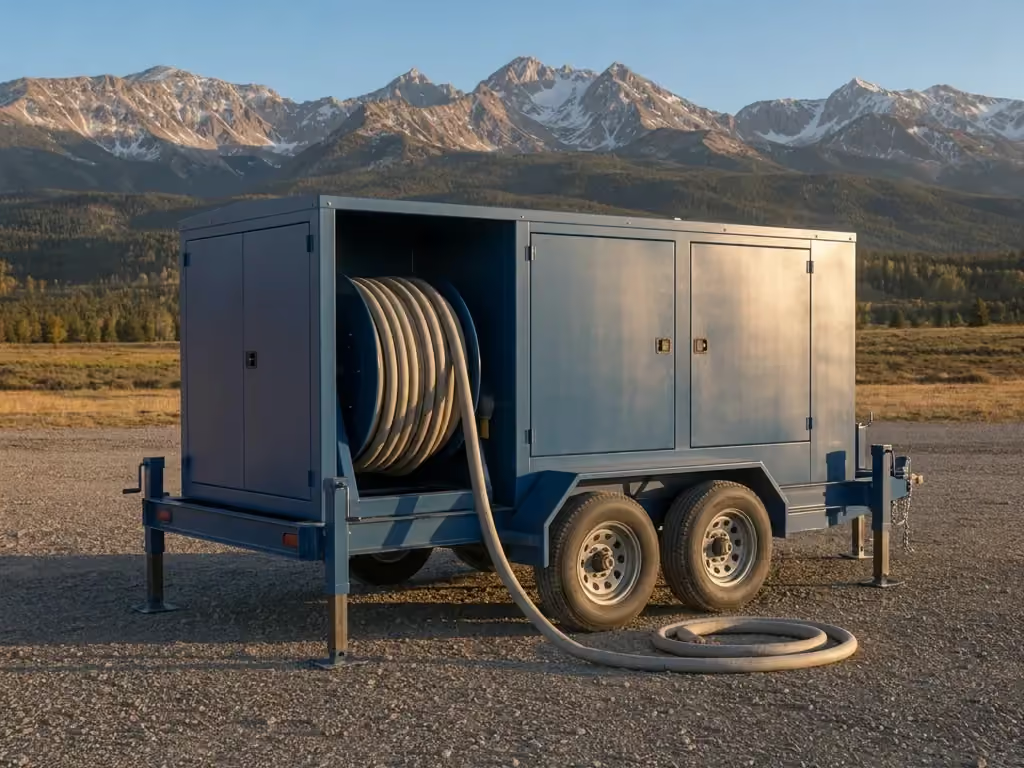
A surface heater heats transfer fluid and pumps it through a closed hose loop. The hose lies in a planned pattern over the treatment area. A vapor barrier and insulating mats above it hold heat near the soil instead of losing it to winter air.
The HSH 700 shows the operating pattern
The Wacker Neuson heating brochure describes the HSH 700 with 700 m of hose and thawing capacity of 204–409 sq m. Those convert to about 2,297 ft of hose and 2,196–4,402 sq ft. JOLT does not publish a heater model, hose length or coverage; the assigned model and specifications are confirmed in writing with the reservation.
The maker's sequence is hose in a snaking pattern, vapor barrier, insulating mats and circulation. Tighter spacing puts more hose into the same area and shortens the maker's charted time. Loose spacing treats more area but changes the schedule.
JOLT's ground-heater rental includes a trailer-mounted hydronic heater, insulated hose on a reel and winter thaw-and-cure use. Thermal blankets are not in the published package. Fuel, blanket sourcing, setup responsibility and the assigned model need named owners before delivery.
Read the maker's soil-and-depth chart
The following values come from the HSH 700 brochure. They use 30 cm hose spacing and assume the soil's water content and insulation support the result. They are planning inputs, never a substitute for field acceptance.
| Soil | Frozen depth | Days the maker publishes |
|---|---|---|
| Sand | 30 cm | 0.75 day |
| Gravel | 60 cm | 2 days |
| Clay | 90 cm | 4 days |
| Sand | 120 cm | 3.25 days |
| Gravel | 120 cm | 4.5 days |
| Clay | 120 cm | 6 days |
| Silt | 120 cm | 7.5 days |
| Silt | 150 cm | 10 days |
How we built this table: We transcribed the 30 cm-spacing column of the Wacker Neuson thawing-times chart for the named model. The brochure says times depend on soil water content and insulation, so a superintendent should round the schedule up and verify the result in the field.
The chart reports elapsed days by soil, depth and spacing rather than one “inches per day” claim. Use that format. Dividing depth by time can hide the conditions and create a false production promise.
How much area and diesel should the plan carry?
The HSH 700's maker lists a 204–409 sq m thawing range. A 2,000 sq ft slab is about 186 sq m, inside that named model's published range before allowing for edges, manifolds and staging. Confirm actual treatment limits against the assigned machine and hose drawing.
Convert full-load fuel use into a daily allowance
The maker lists HSH 700 full-load fuel consumption with generator at 8.3 L/h, about 2.2 gal/h. A continuous 24-hour full-load calculation is about 52.6 gal. Actual consumption changes as the burner cycles, so log fuel added rather than treating that ceiling as a guaranteed burn.
Use the EIA Gasoline and Diesel Fuel Update for the current Rocky Mountain on-highway diesel figure, then multiply the job's gallons by the displayed per-gallon price. Do not bury fuel inside the equipment rent. Assign refueling access, storage and daily checks separately.
The ground heater rents for $1,450/mo in season, has a $1,000 reservation deposit and a 1-month minimum. JOLT publishes no off-season rate. Delivery is additional when the heater travels alone.
Coverage for curing is an engineering decision
The HSH 700 brochure lists concrete-curing performance separately from thawing: 409 sq m with the standard hose, about 4,402 sq ft, and 1,128 sq m with accessories, about 12,142 sq ft. Those are the maker's figures for that model, not JOLT's assigned heater, and the approved hose spacing, edge treatment, blankets or enclosure, sensors and weather still determine the cure coverage a given slab gets.
The ACI 306R-16 preview defines a hydronic heater in Section 2.2 as a mobile system pumping heated fluid through closed-circulation tubing and a heat exchanger. Sections 9.4 and 10.2 address hydronic insulation and curing inside an enclosure, but the public preview does not expose a universal cure layout. Confirm those details with the engineer of record.
What happens after concrete is placed?
Thaw mode prepares the bearing surface. Cure mode protects fresh concrete after finishing. The hose, insulation and monitoring locations may change between those operations, so show both layouts on the winter plan.
Blankets retain heat while an enclosure controls air
Blankets work directly over a slab when the approved method can maintain concrete temperature across the field, corners and edges. An enclosure creates a larger controlled space for crews, forms and exposed surfaces. Either approach needs measured concrete temperatures, not only heated-air or fluid readings.
The ACI 306R-16 preview says in Section 4.3 to maintain concrete at or above the recommended placement temperature for the Chapter 7 period. Section 4.3 also says that duration depends on cement type, accelerator dosage and service conditions. The engineer of record must state the number of cure-protection days because the accessible source does not publish one value that fits every slab.
The ACI 306R-16 preview warns in Section 3.1(d) against rapid temperature changes and calls for gradual removal over the next 24 hours at the end of protection. Plan a controlled step-down. Pulling every cover at sunrise can create a steep surface change even after strength has developed.
Keep light and storage out of the heat plan
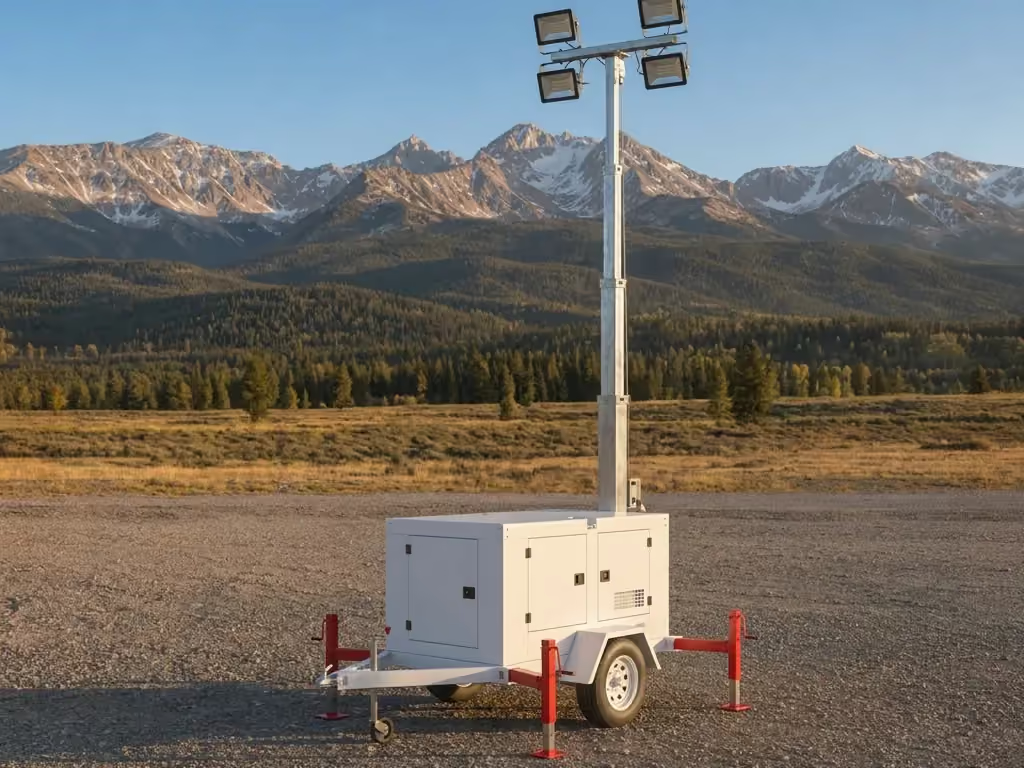
A light tower extends work into short winter days with four LED floodlights on a mast reaching about 30 ft. It rents for $1,250/mo with a 1-month minimum. Lighting helps inspections and finishing but does not prove concrete temperature.
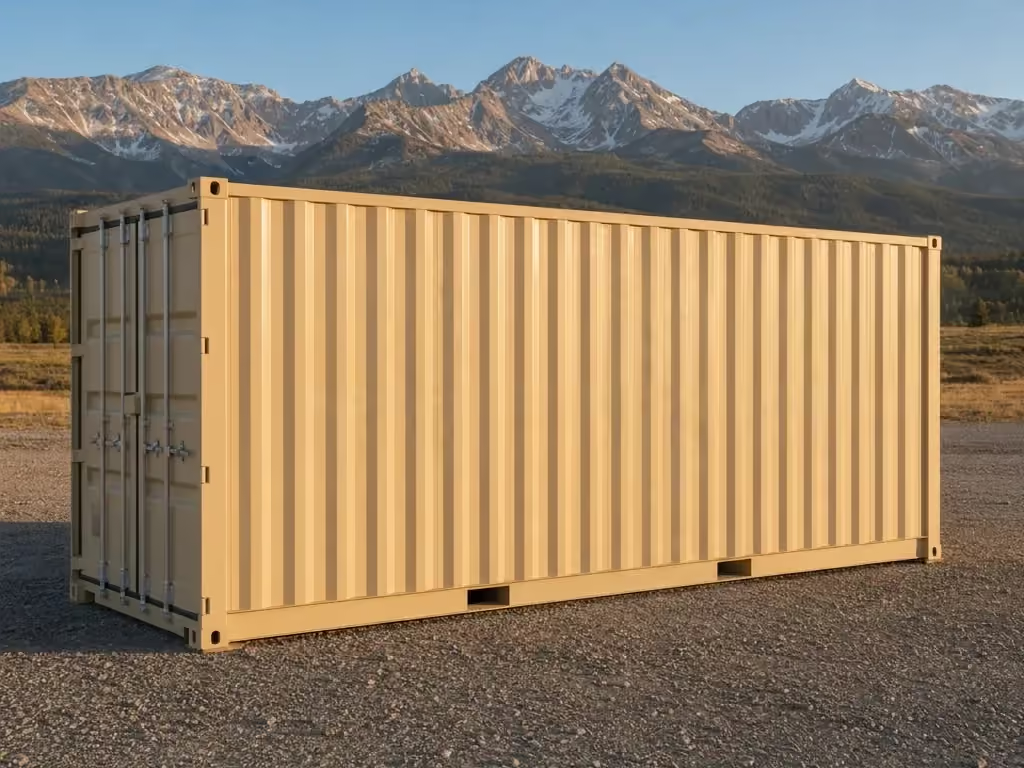
A 20 ft storage container keeps customer-supplied blankets, sensors and tools under lock for $295/mo. Keep wet or frozen covers separated from instruments. Stage both outside the heater's hose path and retrieval route.
What does a January 2,000 sq ft slab sequence look like?
This example uses a 48 in planning depth, equivalent to about 120 cm, because Eagle County publishes that frost-depth reference. It assumes silt and the HSH 700 chart's tighter 30 cm spacing, producing 7.5 charted thaw days. Round that to 8 scheduled days and keep field acceptance as the hold point.
Work backward from the pour
Day 1 — delivery and layout
Place the assigned heater on an accepted, accessible spot. Confirm model, fuel, hose inventory, instructions and setup responsibility in writing. Stake the 2,000 sq ft treatment area, lay the approved hose pattern, then place the vapor barrier and insulating mats.
Days 2–9 — run an 8-day thaw window
The maker charts 7.5 days for 120 cm of silt at 30 cm spacing, depending on water content and insulation. The schedule rounds up to 8 full days. Log operation, fuel and observed conditions, and protect hose crossings from equipment.
Day 10 — expose and accept subgrade
Open only the area the geotechnical lead is ready to inspect. Verify thaw depth, moisture, bearing and drainage by the project's approved method. If frozen or weakened material remains, restore covers and extend heat instead of forcing the next activity.
Day 11 — forms, reinforcement and pre-pour review
Complete final preparation after acceptance. Remove ice, snow and frost, check weather, concrete delivery, sensors, blankets or enclosure, backup heat and the approved placement temperature. Give one person authority to stop the pour if a hold point fails.
Day 12 — place and switch to cure mode
Record concrete temperature at discharge and placement as required by the project plan. Finish, place sensors and shift hose and insulation to the approved cure layout. Protect corners and edges immediately rather than waiting for the whole slab.
Engineer-set protection days — cure and record
Maintain the project-specific temperature and protection period written by the engineer of record. The source available here supports 500 psi as an early freeze-resistance benchmark and 48 hours at 50°F for most well-proportioned mixtures, not a universal release date. Keep protection until the approved strength or duration criterion is met.
Final 24 hours — remove protection gradually
Step down heat and insulation as the approved plan directs. The 24-hour gradual-removal period comes from the cold-weather guidance. Keep recording edge and surface temperatures while the slab moves toward ambient conditions.
Pickup after written notice
Clean and reel hose as instructed, restore fuel to the delivered level and preserve truck access. JOLT requires at least 15 days' written pickup notice, and rent continues until retrieval. Do not let another subcontractor bury the trailer behind material or snow.
The sequence has one deliberate open duration: cure protection. That number cannot be taken from the public summary without the member, mixture, service condition and approved strength method. Put the engineer's value into the live schedule before Day 12.

When should the equipment be reserved and delivered?
The published winter season for ground heaters and light towers runs October 1 through March 31. Reserve by October 15 for the November window. For later pours, still carry the standard 2–4 week delivery window instead of waiting for a short-range forecast.
Build the reservation around one written scope
Send the job address, needed week, work area, observed or design depth, soil description, access constraints and planned thaw and cure uses. Ask the yard to confirm the assigned heater model, its specifications, fuel type and setup responsibilities in writing. Do not release a production schedule against an unidentified machine.
Use the delivery-zone table for the job address. A ground heater is towed, so it pays one zone fee per unit each way whether or not a container is on the same order; only fence, traffic control and hand-wash lines ride with a container at no added charge. Zones A–E price pickup as a second leg, while Zone F pickup is quoted in writing before delivery.
The jobsite setup checklist coordinates access, power, storage and snow operations. The winter office answer handles crew space, not slab heat, and the off-grid office guide covers a heated office on a pad with no utility power yet. For a construction mobilization, use the construction-jobsites plan and published pricing to keep equipment rent, fuel, blankets and delivery as separate lines.
Protect the delivery and pickup paths
Plow and sand the trailer set, hose-reel working side and fuel access before dispatch. Keep the trailer outside excavation, crane swing, haul routes and snow storage. Mark hose crossings or close them to traffic.
Review the mountain delivery guide before committing to a narrow or steep approach. A site representative must direct placement. Preserve that same route for refueling, service and pickup after the slab is protected.
Call 970-279-1015 with the job address and requested week when the plan is ready. The useful conversation is specific: 2,000 sq ft, measured soil condition, separate blankets, named setup owner and an approved thaw-to-cure sequence.
What JOLT rents for this
The units this guide prices, at the rates on their own pages. Reserve one online or call the yard.
Questions contractors ask
How long does thawing take?
Plan from soil, measured frozen depth, hose spacing and insulation, not one universal production rate. The HSH 700 maker's chart spans 0.75 day for 30 cm of sand at 30 cm spacing to 14 days for 150 cm of silt at 45 cm spacing. Verify thaw by field observation before excavation or placement.
How much fuel does a hydronic heater burn?
The named HSH 700 example lists 8.3 liters per hour at full load with its generator, about 2.2 gallons per hour or 52.6 gallons across 24 continuous hours. Actual daily use follows burner cycling, weather and setup. Confirm the assigned heater and fuel plan in writing, then multiply gallons used by EIA's current regional diesel price.
Can I pour on frozen ground if the mix has accelerator?
No, an accelerator does not make frozen subgrade acceptable. CDOT's cold-weather limits say concrete shall not be placed on frozen ground and require ice, snow and frost to be removed from formwork. The project specification and engineer of record still control the approved mix, placement temperature, protection method and strength verification.
What is the coldest temperature at which I can pour?
There is no responsible single outdoor cutoff for every pour. Cold-weather planning begins when air falls or is expected to fall below 40°F during protection, while concrete temperature, member size, wind, mix and protection govern the operation. Have the engineer of record provide the placement and protection values for the actual member rather than using one ambient number.
Do I need both blankets and a heater?
Usually the hydronic layout needs insulation above the hose to retain and spread heat. The HSH 700 maker describes hose in a snaking pattern, then a vapor barrier and insulating mats. JOLT's published package includes the trailer-mounted heater, insulated hose and reel, but not thermal blankets, so schedule covers separately and confirm the complete layout.
How many square feet does one ground heater cover?
The HSH 700 maker publishes a thawing-capacity range of 204–409 square meters, about 2,196–4,402 square feet, depending on layout. That is a named-model reference, not a promise for every JOLT rental. JOLT publishes no model or coverage figure, so the assigned heater and its written specifications are confirmed with the reservation before the pour schedule is released.
Who sets up the hydronic hose?
Setup responsibility is confirmed in writing with the reservation. JOLT publishes no crew size, installation time or promise that field hose layout is included. Assign the superintendent, approved operator and concrete lead before delivery, and identify who lays hose, supplies vapor barrier and blankets, checks fuel, records temperatures, moves covers and prepares the equipment for pickup.
How far ahead should I book a winter heater?
Carry the standard 2–4 week delivery window. For the November window, reserve heaters and light towers by October 15; the published winter season runs October 1 through March 31. Book only after the work area, access, separate blankets, fuel responsibility and assigned model can be confirmed, because the model's coverage and thaw chart drive the field sequence.
Ready when your site is.
Rentals from $85/mo · every price published
A deposit holds your delivery window. Cancel free of charge more than 14 days before the first day of the window. Deposits from $85 are applied to your first invoice.